
Arm Lift
Brachioplasty
A personal choice. Understand the anatomy, options, preparation, recovery and limits.
01 · The basics
Understanding an arm lift
An arm lift, or brachioplasty, removes excess skin from the upper arm and may reduce selected fat. The central choice is a contour change in exchange for a permanent scar.
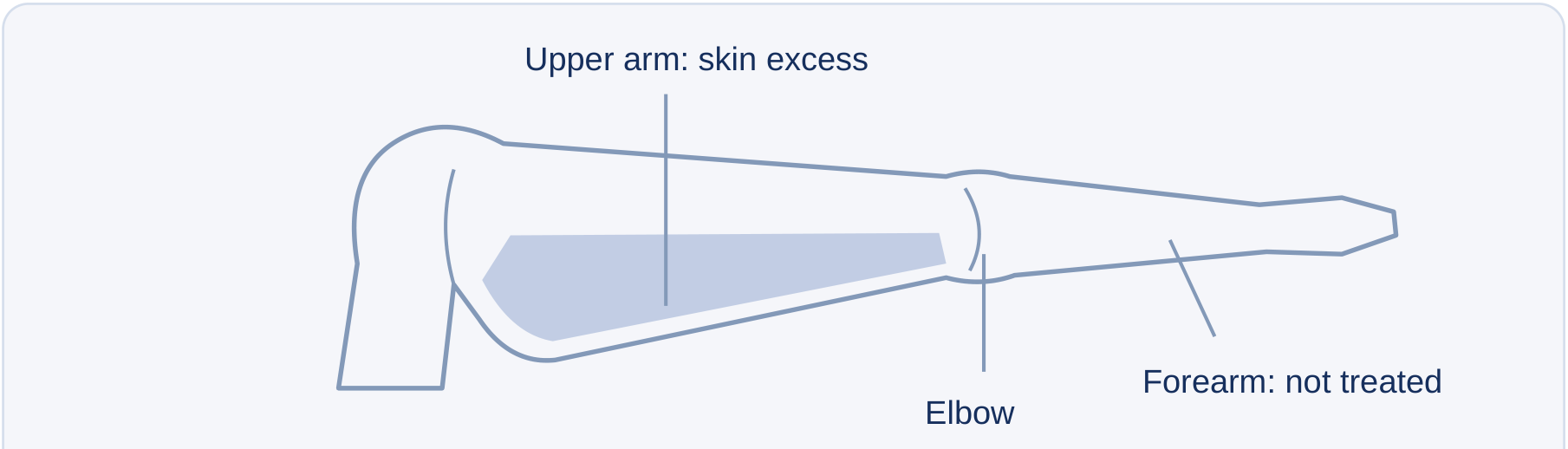
Educational schematic, not an individual surgical plan or a prediction of results.
Skin excess is different from fat
Weight change, aging and inherited skin characteristics can leave loose tissue along the inner or back portion of the upper arm. Liposuction reduces selected fat but does not remove substantial excess skin. Exercise can strengthen muscle without reliably tightening a hanging skin fold. The examination determines which tissues are contributing.
What an arm lift may offer
Removing skin and reshaping supportive tissue may improve the upper-arm contour. Some people also seek relief from rubbing or difficulty with clothing and hygiene. Tell the surgeon whether your main concern is appearance, comfort or both. The operation is not a weight-loss treatment and does not guarantee a particular arm size or perfect symmetry.
Accept the scar before choosing surgery
A longer skin excess often requires a longer scar, usually on the inner or back-inner upper arm. A short armpit-only option is suitable for selected limited excess near the axilla, not everyone. If you would not accept a visible scar, ask about alternatives or not having surgery.
Timing matters
A stable weight, good general health, no nicotine use and realistic expectations help guide candidacy. If further weight loss is planned, discuss timing before booking. Later weight changes and aging may stretch the tissues again; no result is permanent in every respect.
02 · Before surgery
Consultation & preparation
The consultation should connect your goals with your skin distribution, health and daily activities. The amount of loose skin (not a promise of a tiny scar) guides the plan.
Bring relevant information
- Explain weight changes, previous weight-loss surgery, arm or breast operations, scars and any previous healing difficulty.
- List health conditions, allergies, all medicines, vitamins, herbs and supplements, plus alcohol and nicotine use.
- Mention arm swelling, previous lymph-node treatment, altered sensation, nerve symptoms, bleeding or clotting history.
Examination and planning
The surgeon assesses skin and fat from the armpit toward the elbow, differences between arms, tissue quality and any excess extending toward the side of the chest. Measurements and photographs help document the starting point. Discuss where the scar may sit when the arm is down or raised, and whether the plan includes chest extension or optional liposuction.
Prepare safely
Medical evaluation and tests may be needed. After substantial weight loss, ask whether nutrition or other health issues need review before healing a long incision. Obtain an individual nicotine-cessation plan. Review medicines that affect bleeding or healing, but never stop prescribed treatment without agreement from its prescriber.
Arrange help for ordinary tasks
Plan transport and an adult for the first night, with extra support as needed. Dressing, washing, preparing meals and caring for children may be difficult while arm movement is restricted. Confirm fasting, washing, arrival and after-hours contact instructions.
Make the scope clear
Ask whether surgery is day-case or may require observation overnight, who provides anesthesia and how complications are managed. Combining operations may add recovery demands. The consent discussion should cover alternatives, permanent scars, activity restrictions and the possibility of further treatment.
03 · On the day
Procedure & incisions
Arm-lift incisions vary with the extent and position of excess skin. They treat the upper arm between the armpit and elbow, not a routine line down the forearm.
Anesthesia and monitoring
The anesthesia plan may use general anesthesia or intravenous sedation with appropriate local anesthesia. The team recommends an option based on your health and the extent of surgery. Monitoring and a suitable surgical facility are essential; discharge arrangements are individualized.
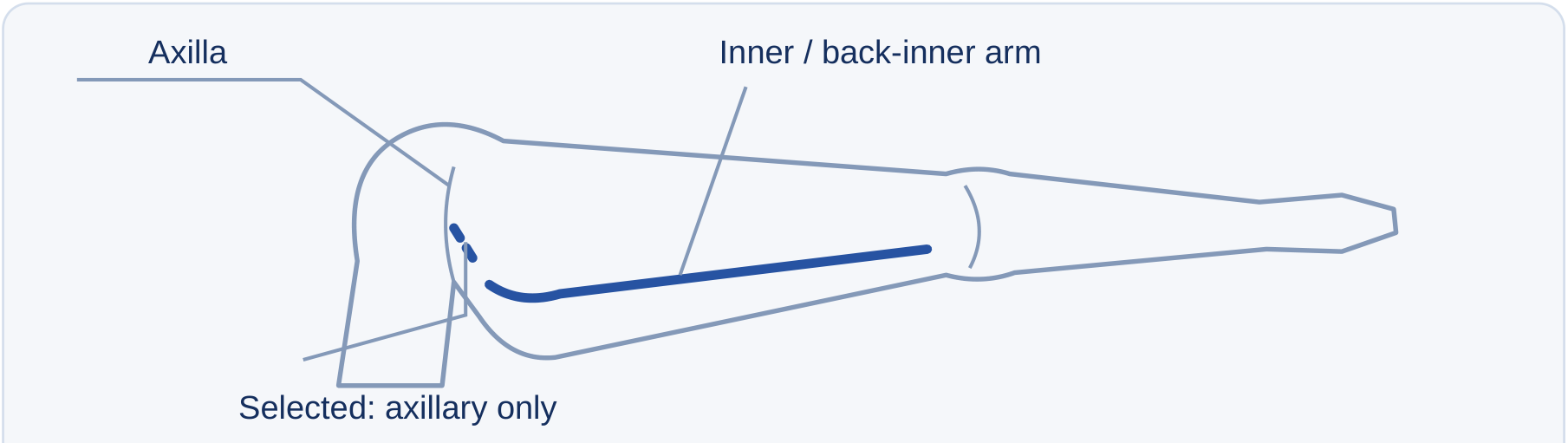
Educational schematic, not an individual surgical plan or a prediction of results.
Incision options, not one universal pattern
An incision commonly follows the inner or posteromedial upper arm from the axilla toward just above the elbow; its length depends on the skin excess. A limited incision within the armpit can address selected small upper-arm excess but cannot correct widespread laxity along the whole arm. Extension toward the side of the chest may be needed in some patients and adds scar length.
Reshaping the tissues
Excess skin is removed and underlying supportive tissue may be reshaped with internal sutures. Selected fat may be removed directly or by liposuction, depending on the plan. This is not routine tightening of the arm muscles, and liposuction does not replace excision when substantial loose skin is present.
Closure and initial protection
Absorbable or removable sutures close the skin. Dressings, a temporary drain and prescribed compression may be used. Your team should explain what is present, how to care for it and when it will be checked. Do not remove drains or alter wraps yourself.
Scars remain
Scars can widen, thicken or remain noticeable even after careful placement. The drawings show possible access only; they are not cutting instructions and do not show every variation. Agree the likely scar extent with your surgeon before surgery.
04 · After surgery
Recovery & results
Healing is individual. Your job, the incision length, any additional surgery and your health all affect when you can safely resume normal activities.
Follow the written plan
Bruising, swelling, discomfort and altered sensation may be present early. Learn wound and drain care, prescribed medicine use and the timing of review. Dressings and stitches are checked or removed according to healing, not a universal date. Do not apply unapproved creams to an open incision.
Protect long upper-arm incisions
Avoid excessive pulling, friction or pressure on healing wounds. Ask how far to raise or move your arms and when lifting, pushing, carrying children and overhead activity are safe. Do not choose a weight limit or stretching program from a generic guide. Gentle movement and individualized clot prevention are directed by the team.
Compression is a prescription, not a shortcut
Wear a sleeve or wrap only if the team prescribes it and explains fit and duration. Do not tighten it yourself or assume that more pressure improves the contour. Report increasing pain, numbness or hand swelling so circulation, nerves and garment fit can be assessed.
Returning to everyday life
Ask for individual clearance for work, driving, showering, exercise and underarm grooming. A desk job and manual work make different demands. Do not drive while sedated by medicines or unable to control the vehicle safely. Swelling and scars settle over months; scars remain permanent, and weight changes or aging can alter the contour.
Seek help promptly
Contact the team for fever, spreading redness, increasing pain, significant drainage, wound opening or new arm or hand swelling. Sudden breathlessness, chest pain or collapse require emergency care immediately, not a routine clinic message.
05 · An informed decision
Risks & safety
Brachioplasty has specific wound, nerve and lymphatic risks as well as the general risks of surgery. Review them before deciding whether the scar trade-off is acceptable.
Bleeding, infection and general risks
Bleeding or a hematoma can require treatment. Infection, anesthesia complications and blood clots, including pulmonary embolism, are possible. Your personal health and the extent of surgery affect risk; an operation described as cosmetic is not risk-free.
Wound healing and tissue loss
Long wounds may heal slowly or open apart, called dehiscence. Fluid collections, including seroma, can need drainage. Poor blood supply can lead to skin loss or fat necrosis. Extra dressings, medicines or surgery may be required, and recovery can take longer than expected.
Nerves and lymphatic drainage
Nearby nerves can be injured, causing numbness, altered sensation, pain or functional symptoms that may be temporary or permanent. Damage to lymphatic tissue can cause persistent arm swelling, called lymphedema; it is an uncommon but important risk to discuss, distinct from ordinary early swelling. Tell the team about previous lymph-node procedures or existing swelling.
Scars, contour and further care
Scars may be conspicuous, wide, raised or uncomfortable. Asymmetry, contour irregularities, remaining or recurrent laxity and dissatisfaction may occur. Deep stitches can surface or irritate the skin. Revision may help selected problems but adds risks, scars, recovery and possible expense; it cannot guarantee perfect symmetry.
Consent should address your situation
This is not a complete list or a prediction of your risk. Ask which complications are most relevant, how nerve and lymphatic structures are considered and what the plan is if a wound opens. Understand who will provide care if recovery is prolonged.
Do not ignore change
New weakness, worsening numbness, sudden swelling or a painful tight arm need prompt clinical assessment. Breathing difficulty or chest pain is an emergency. Contact details on the back page are for the clinic, not a substitute for emergency services.
06 · Planning ahead
Cost & choosing your surgeon
Choose a qualified, experienced plastic surgeon and an appropriate licensed facility. Your surgeon should explain both the contour goal and the care required for long upper-arm wounds.
Ask for an itemized estimate
Confirm the surgeon’s fee, anesthesia, facility, tests, prescribed medicines, dressings, any compression garment and follow-up. Specify whether liposuction or extension toward the chest is included. Fees depend on the agreed scope and care setting; a short-scar label alone does not describe the operation.
Understand further-care arrangements
Ask about charges for extra wound visits, treatment of a complication, longer observation and revision surgery. Find out whether another clinician covers the practice when your surgeon is away. This guide gives no price, financing or insurance promise; clarify any relevant coverage directly with your own insurer before committing.
Questions worth asking
- What are your qualifications and experience with brachioplasty, including patients with skin excess like mine?
- Why is this inner or posteromedial scar appropriate, and what would an armpit-only operation leave untreated?
- How will the plan account for nerves, lymphatic drainage and any previous arm or breast treatment?
- Where will surgery happen, who gives anesthesia and what emergency support is available?
- How much help may I need at home, and how do I reach a clinician after hours?
Choose without pressure
Discuss the balance between a changed contour and a permanent, potentially visible scar. Ask to see relevant examples without assuming an identical result. Compare how clearly teams explain limits, wound care and follow-up rather than choosing on price alone. Taking more time, requesting another opinion or deciding against surgery are all reasonable options.
Book your consultation
Let’s talk about your goals
- Phone +961 1 746345
- WhatsApp +9613307854
- Email psi@psi-lb.com
- Address 63 Souraty Street, Hamra, Nassif Bldg, 1st Floor, Beirut, Lebanon
This guide provides general education only, not individualized medical advice or a treatment plan. It offers no guarantee of results and does not replace a thorough, in-person consultation with a qualified, experienced plastic surgeon. Follow your treating team’s instructions.
Further reading · official patient information
Procedure (opens in a new tab) · Safety (opens in a new tab) · Hospital guide (opens in a new tab)