
Buttock Augmentation
Understand implants, fat transfer, safety, recovery and the limits of surgery.
01 · The basics
Understanding your options
Augmentation uses purpose-designed silicone implants, your own transferred fat, or a selected combination to increase volume, roundness and projection and balance shape.
Two options, not the same operation

Simplified comparison only. Device size and transferable fat volume are limited by anatomy and safety; there is no fixed volume for everyone.
Implants
A dedicated buttock implant is a solid/elastomer silicone device, not a breast gel or saline implant and not liquid silicone injection. The device and its pocket require individualized planning.
Autologous fat grafting (BBL)
Fat is collected by liposuction from selected donor areas, processed and transferred to the buttocks. Enough suitable donor fat is needed; some transferred fat is later absorbed.
Who may be considered?
Healthy adults of any gender, with stable weight, no smoking and realistic expectations may be considered. Donor-fat availability, skin quality, body tissues, goals, activity and individual risks guide the choice. Neither method is universally safest; a lean build does not automatically mean implants are appropriate.
Your body, your decision
Choose surgery for your own reasons, not outside pressure. It is not weight-loss treatment and cannot guarantee confidence or satisfaction. BBL adds volume but does not necessarily lift loose skin. A skin-excision lift for laxity is a separate, selected operation. A combination may be staged; not everyone needs both.
02 · Before surgery
Consultation & preparation
A complete history and an honest discussion of your goals help determine whether any operation is appropriate. You may choose not to proceed.
- Individual tests
- Medicine review
- Stop nicotine
- Ride & adult support
Disclose your full history
- Health conditions, allergies, all previous treatments and surgery; especially prior fillers, liquid silicone or unknown injections.
- All medicines, vitamins, supplements and herbs; alcohol, tobacco, vaping, nicotine and drug use.
- Bleeding, blood clots, poor healing and previous anesthesia problems.
Discuss and assess
- Goals, activity, expectations, examination and medical photographs.
- Skin, donor fat, body tissues, surgery extent and whether staging is better.
- Alternatives, anesthesia, realistic limits, risks and the option to decline; surgery may not be appropriate.
Individual medical preparation
Blood tests or medical evaluation and medication adjustments may be needed. Stop smoking, vaping and nicotine according to your team’s instructions. Aspirin, anti-inflammatory medicines and some herbs can increase bleeding; do not stop prescribed treatment without the prescriber’s agreement.
Facility, monitoring and discharge
Use an appropriately licensed hospital or ambulatory facility with a qualified surgical and anesthesia team, monitoring and an emergency plan. Same-day discharge or an overnight stay is individualized, not a promise of going home after a few hours.
Arrange help and follow-up
Confirm fasting, medicines, clothing and arrival instructions. Arrange a ride and an adult for at least the first night, with help for daily activities as needed. If traveling, plan distance follow-up, emergency access, who manages complications and when travel is appropriate.
03 · Two separate pathways
Procedure & fat-grafting safety
Implants and fat transfer are different operations with different tissue planes. Anesthesia (intravenous sedation or general anesthesia) is individualized to health and surgical extent.
Implant pathway
A purpose-designed solid/elastomer silicone implant is placed through a selected incision, often in the intergluteal crease; other patterns depend on the case. The implant pocket is defined by surgeon and device, distinct from fat injection, for example within muscle or another anatomically appropriate pocket. Size limits are planned. Layered sutures, adhesive or tape close the wound; drains may be selected.
Fat-transfer pathway
Liposuction removes donor fat; a solution containing dilute local anesthetic may be used. Processed fat is transferred in a safety-limited, individualized volume. Fat must be injected only into subcutaneous tissue above the gluteal fascia, not into or below muscle. Safety guidance recommends real-time ultrasound to visualize the cannula tip during injection, not just mapping beforehand.
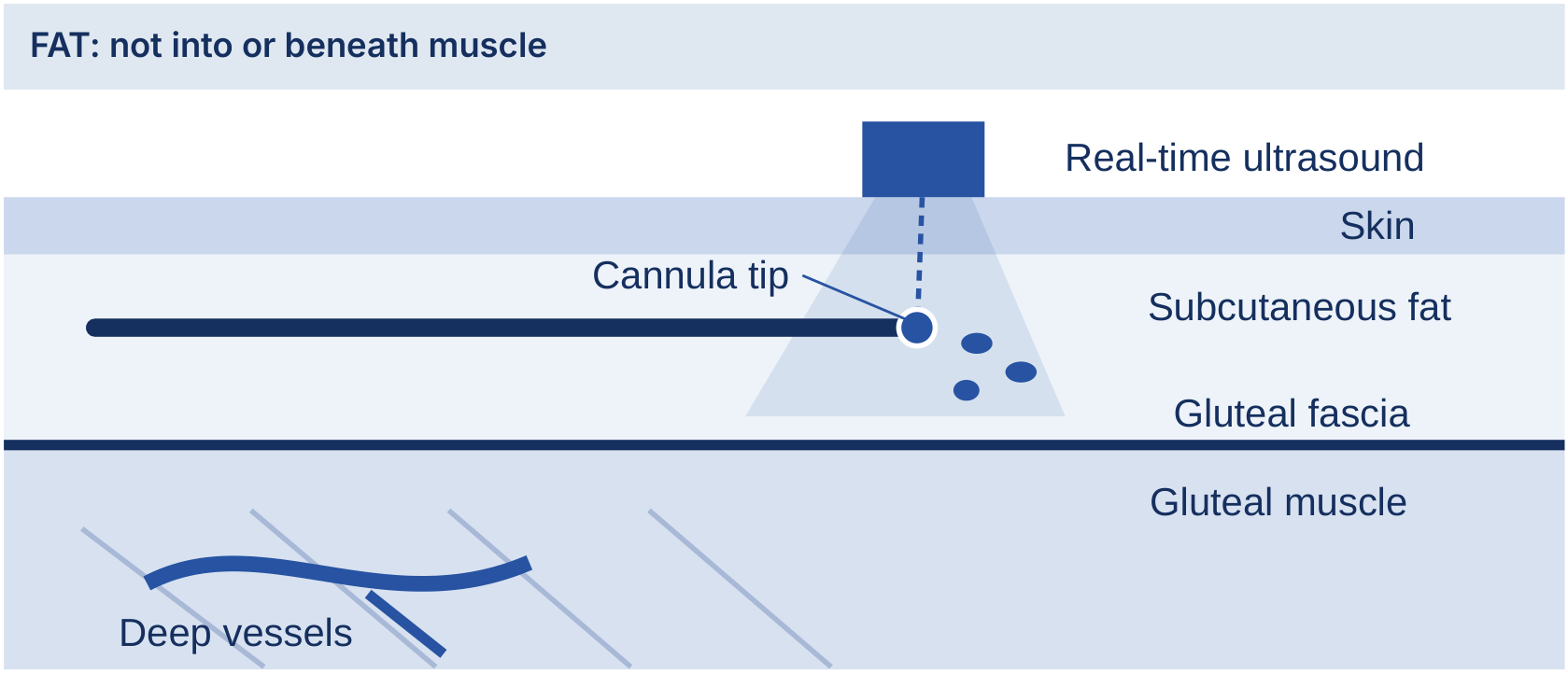
Illustrative anatomy, not an operating guide. The probe tracks the cannula tip during injection. Not all vessels are drawn; vessels also exist in superficial tissues. Ultrasound and superficial placement do not eliminate potentially fatal fat embolism.
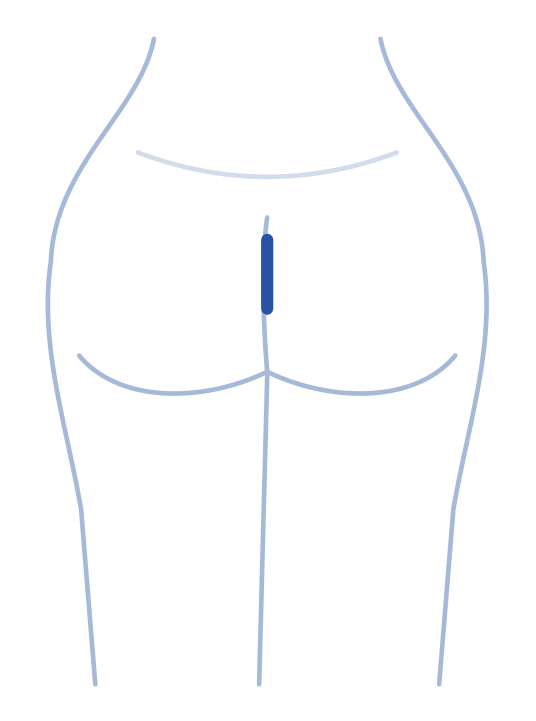
Implant incision example in the intergluteal crease; individual variants are not all shown. Scars are permanent; complete concealment is not promised.
Selected combinations may be staged. An implant pocket must never be mistaken for an acceptable fat-injection plane.
04 · After surgery
Recovery & results
Your written care plan takes priority. Recovery depends on the operation and any combined procedures; there is no universal sitting position or return-to-activity date.
Early care
Monitoring, pain relief and help at home; learn dressing and any drain-care instructions. Do not remove drains yourself.
Healing & review
Swelling and bruising may last weeks. Follow-up guides activity and any suture or drain removal.
Settling over months
Final contour takes months; fat-transfer results may take up to a year to settle. This varies individually.
Implants: protect wound and device
Limit pressure, friction, wound tension and sudden movements as directed. Ask which sitting, sleeping and cushion arrangements protect your specific operation; combined procedures can change positioning.
Fat grafts: protect transferred tissue
Avoid prolonged direct buttock pressure for the period your surgeon specifies. If a cushion is recommended, support the thighs to keep pressure off the graft as instructed. Do not assume a fixed two-week restriction or a universal prone-sleeping plan.
Movement, garments and care
Gentle walking and individualized clot prevention are important; do not remain immobile. Garments are used only as directed, usually for liposuction zones, not tight compression onto new grafts. Avoid aggressive massage over grafts or implants; massage is only for a prescribed time and site with a qualified therapist, not routine for everyone.
Ask about bathing, dressings, stitches, drains, garments, positioning, sitting, work, driving, exercise and follow-up. Resume exercise only when cleared; do not drive while taking impairing opioids or before the team clears you.
Results and longer-term care
Some fat is absorbed; surviving fat changes with weight. Scars remain permanent, asymmetry may persist and revision may be needed. Aging, gravity and weight changes affect results; healthy habits help but do not guarantee them. Devices are not guaranteed for life and may need future surgery. Keep the device card and operative record; follow individualized long-term review and seek assessment for new pain, swelling or changes.
05 · Informed decisions
Risks & safety
Both options have important risks. Gluteal fat grafting carries an elevated risk of serious complications compared with other elective cosmetic operations.
Shared surgical risks
- Anesthesia complications; infection; bleeding, excessive blood loss or hematoma.
- Bruising, swelling, fluid accumulation (seroma), poor healing and permanent/unfavorable scars.
- Blood clots, deep vein thrombosis, cardiac or pulmonary complications.
- Numbness, persistent pain, asymmetry and possible revision surgery.
Implant-specific risks
- Wound separation with implant exposure; infection or exposure may require removal.
- Nerve injury, including sciatic-nerve pressure causing pain or injury.
- Firmness or capsule formation; device damage or rupture.
- Malposition or migration; further device-related surgery may be needed.
Fat transfer and liposuction
- Fat necrosis (death of fat), oil cysts and contour irregularity.
- Fluid shifts, lidocaine toxicity and other liposuction/anesthesia risks.
- Stretch marks and cellulite may persist, develop or worsen, not reliably be corrected.
Fat embolism can be fatal
Fat entering the bloodstream can obstruct large blood vessels, the heart or lungs, not simply cause inflammation. Real-time ultrasound and injection only above the gluteal fascia are important safeguards, but do not eliminate this risk. Your own fat does not make surgery risk-free.
Get emergency help immediately
Breathlessness, chest pain, collapse, confusion or new weakness need immediate emergency assessment for possible embolism or another serious complication. Do not wait for a clinic reply. Fever, worsening redness or drainage, skin-color change, wound opening or a visible implant need prompt urgent contact with the treating team.
This is not an exhaustive risk list or a substitute for individualized informed consent. Ask how your risks will be reduced and how complications would be treated.
06 · Planning ahead
Cost & choosing your surgeon
Choose a qualified, experienced plastic surgeon, an appropriate facility and a clear care pathway, not a price or volume promise.
- Surgeon
- Anesthesia
- Facility
- Tests
- Medicines
Request an itemized written quote
Check surgeon, facility and anesthesia fees; implant costs if used; donor-area care, tests, medicines, dressings, compression and any special cushion if prescribed. Clarify follow-up, possible revision, future device surgery or maintenance and extra care. Costs depend on the plan, extent and experience; no fee or financing is promised here.
Check your insurance contract directly
Cosmetic surgery and its complications are often excluded. Ask your insurer to confirm your own contract in writing; do not assume coverage or reimbursement.
Questions that matter for safety
- What are your qualifications and experience with this particular procedure? Why is this option suitable, and what are the alternatives or reasons not to operate?
- For fat transfer: what is your ultrasound training? Will you monitor the cannula tip in real time throughout injection and keep all fat only subcutaneous, above the gluteal fascia?
- Will the qualified surgeon perform the critical steps rather than untrained delegates? How are workload and concurrent surgery managed to avoid rushed care or overload?
- Is the hospital or ambulatory facility appropriately licensed, with qualified anesthesia staff and monitoring? What is the emergency response and hospital-transfer plan?
- Who is responsible for postoperative care and complications, including if I travel? How do I reach them after hours?
- For implants: what device, pocket and incision do you propose? What records, long-term follow-up and possible future operations should I expect?
Take time to weigh the plan and consent discussion. Neither a larger volume, a smaller scar nor a lower fee should override safety or your choice to decline.
Book your consultation
Let’s talk about your goals
- Phone +961 1 746345
- WhatsApp +9613307854
- Email psi@psi-lb.com
- Address 63 Souraty Street, Hamra, Nassif Bldg, 1st Floor, Beirut, Lebanon
For general education only: not individualized medical advice or a treatment plan. This guide gives no representation, warranty or promise of outcome. It does not replace a thorough, in-person consultation with a qualified, experienced plastic surgeon or the treating team’s instructions.
Safety reference (2022) (opens in a new tab) · Safety advisory (2019) (opens in a new tab) · Fat-transfer overview (opens in a new tab)