
Breast Reconstruction
Your body, your choices and a coordinated plan for care.
01 · Understanding reconstruction
The basics, choices & timing
Reconstruction recreates a breast mound after mastectomy, or in selected cases after lumpectomy or trauma. It does not recreate the original breast.
One or both breasts may be treated. Breast and donor-site scars are permanent. Sensation is altered: some feeling may return, but normal sensation is not guaranteed. Reconstruction does not restore breastfeeding on a mastectomy side.

Conceptual choices, not predicted results. No reconstruction and an external prosthesis are also valid options.
Your choices are valid
Implants form a mound using a device; autologous reconstruction uses your own tissue, sometimes with an implant. Choosing no reconstruction, an aesthetic flat closure or an external breast prosthesis is equally valid. Flat closure is a planned chest-contouring operation, not simply omitting reconstruction.
You do not need to feel positive or cope “perfectly” to discuss options. Take time; request nursing, counseling or peer support if helpful.
Immediate or delayed
Immediate reconstruction begins at mastectomy. Delayed reconstruction can begin months or years later. Coordinate breast surgery, plastic surgery and oncology: necessary cancer treatment must not be delayed.
Timing depends on mastectomy type, cancer stage, chemotherapy/radiotherapy, health, skin blood supply, donor tissue, previous scars, goals and preferences. Radiation can increase healing and capsular complications; it is not an absolute bar to every implant or a rule that all reconstruction must wait.
Implant features are separate decisions
Filling: saline is sterile salt water inside a silicone shell; rupture usually causes deflation and the fluid is absorbed. Silicone gel rupture may be silent, without collapse. Shape: round versus anatomical is different from gel cohesiveness; cohesive does not always mean teardrop. Rotation of a shaped implant can distort contour. Surface: discuss smooth/textured trade-offs, rippling and movement; textured implants carry higher BIA-ALCL risk. Availability varies.

Implants are not lifetime devices. Further operations and device monitoring may be needed. Keep your patient implant card and read the manufacturer’s leaflet. Several stages are common with any reconstruction; surgery on the other breast for symmetry is optional.
02 · Before surgery
Consultation & preparation
A useful consultation connects your cancer care, health, anatomy and priorities. Anxiety or uncertainty deserves support, not exclusion.
Bring your history
- Cancer diagnosis, pathology and previous/planned chemotherapy or radiation; relevant genetic information if already known.
- Medical conditions, diabetes, clotting or healing problems, allergies and previous operations, including abdominal, back or thigh surgery.
- All medicines, steroids, anti-estrogen treatments, vitamins and herbs; tobacco, nicotine/vaping, alcohol and other drug use.
- Nutritional concerns, available help, activity needs and what matters most to you.
Expect an individual assessment
The team examines and measures breasts and possible donor areas, assesses skin and circulation, reviews scars and discusses photographs with consent.
Tests depend on your health and planned procedure. Circulation studies or CT angiography may help selected flap plans; they are not routine for everyone.
Discuss alternatives, likely appearance, sensation, scars, stages, risks, anesthesia and the possibility of changing the plan. Ask which procedures the team actually provides.
Prepare safely with your team
- Arrange a medical evaluation and indicated tests. Review aspirin, anti-inflammatory medicines and supplements that may increase bleeding.
- Do not stop prescribed anticoagulants, hormone or cancer medicines yourself. Changes require coordination with the prescriber and oncology team.
- Follow the team’s nicotine-cessation plan and instructions on fasting, washing and medicines on the day of surgery.
- Arrange transport, an adult for the first night after discharge and longer help when needed, including childcare and household tasks.
Hospital and anesthesia planning
Most major reconstructions take place in hospital under general anesthesia, with admission according to the procedure and your health. Selected minor later stages may be outpatient procedures with local anesthesia and sedation. Do not assume every stage is day surgery.
Questions to take home
Who coordinates my oncology and reconstruction plan? How could radiation change it? Which donor site is suitable, and why? Is microsurgery needed? How many stages might I need? What support and time away from work or caring duties should I arrange?
A second opinion and time to consider choices are reasonable. Emotional or reconstructive-nurse support is an option, not an eligibility test.
03 · Your individualized plan
Techniques & tissue options
Implants and living-tissue flaps are different routes. The best fit depends on your tissue, treatments, health, desired volume and specialist expertise.
Implant reconstruction
Two stages: a temporary tissue expander is gradually filled at clinic visits, then exchanged for an implant. Direct-to-implant: selected patients avoid an expander, but may still need later surgery. Placement may be above the pectoral muscle (prepectoral) or partly below it, depending on tissue coverage and circulation. An acellular dermal matrix (ADM) may provide a scaffold in selected cases; discuss product-specific risks: it does not eliminate infection or rejection-related problems.
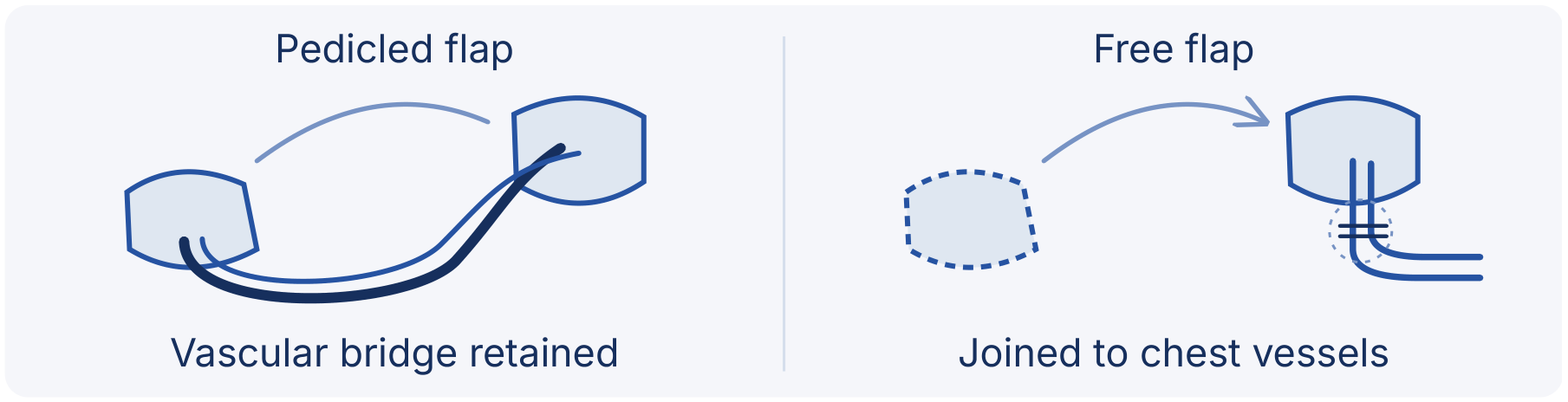
Conceptual diagram only, not an operative guide. Arrows show tissue repositioning, not blood-flow direction. Free-flap vessels are reconnected to restore circulation.
Autologous flaps transfer your own skin, fat, blood vessels and sometimes muscle. A pedicled flap stays attached to its blood supply as it moves to the chest. A free flap is disconnected, then its vessels are rejoined to chest vessels by microsurgical anastomosis; a specialist team and flap monitoring are essential.
| Flap / donor site | Tissue and connection |
|---|---|
| TRAM · abdomen | Includes part of the rectus abdominal muscle; pedicled or free. |
| DIEP · abdomen | Skin, fat and vessels; muscle preserved, but vessels are dissected through muscle. Free flap. |
| SIEA / SIEP · abdomen | Same skin/fat region, different superficial vessels; muscle-sparing free flap only if vessels are suitable. |
| LD · back | Latissimus dorsi muscle, with or without skin/fat; usually pedicled, rotated or tunneled to the chest; often combined with an implant. |
| SGAP / IGAP · buttock | Skin, fat and vessels; muscle-sparing free flaps. Not buttock fat injection. |
| TUG / TMG · thigh | Inner-thigh skin/fat and gracilis muscle; free flap. |
| PAP · thigh | Upper-thigh skin, fat and vessels; muscle-sparing free flap. |
Donor scars, contour change and weakness depend on the flap. Muscle preservation does not mean zero weakness, bulge or hernia risk; LD may affect shoulder function. Tissue volume, vessel anatomy and past scars influence suitability. An abdominal flap is not a guaranteed tummy tuck.
Optional finishing stages
Fat grafting (lipofilling) uses processed fat from your own body to refine contour; some is resorbed and repeat treatment may be needed. Nipple preservation depends on cancer/anatomy and the breast team. Later nipple/areola reconstruction or 3D tattooing and opposite-breast symmetry surgery are optional; neither restores normal sensation nor guarantees appearance.
04 · After surgery and beyond
Recovery & follow-up
Recovery involves the breast and any donor site. Your written plan (not a universal calendar) guides each stage.
Early care
Ask where you will recover and when you can go home. Follow instructions for breast/donor dressings, bathing, stitches and prescribed medicines. If drains are used, record output and care for them as directed; ask when they may be removed.
Use a support bra or garment only if prescribed; tight pressure may harm a flap. Follow your pain plan; a pain pump is an option for selected cases, not a requirement. Do not apply pressure, heat or ice to a flap unless explicitly instructed. Numb skin is vulnerable to burns and cold injury.
Movement and daily life
Gentle walking and the team’s clot-prevention measures support recovery. Follow gradual arm/shoulder exercises or physiotherapy and donor-site restrictions.
Ask about lifting, driving, work, exercise and childcare; resume only when cleared. Implants generally have a shorter initial recovery than free flaps, but staging adds visits. Donor-site recovery can take weeks to months; ask for your own estimate.
Swelling, scars and shape change over months. Further stages or revisions may be needed; lifelong durability and exact symmetry are not guaranteed.
Do not wait for a routine appointment
Call your surgical team immediately for a new flap color/temperature change, sudden pain or rapid swelling: impaired blood flow can need urgent surgery. Follow your team’s specific monitoring instructions. Fever, worsening redness or drainage also need urgent team advice. Chest pain, difficulty breathing or collapse: seek emergency care.
Cancer follow-up is not implant monitoring
Reconstruction does not eliminate cancer risk or replace oncology follow-up. After mastectomy, the reconstructed side usually does not have routine screening mammograms; clinical monitoring and assessment of symptoms continue. Any remaining native breast continues screening. After lumpectomy, breast surveillance continues. Nipple-sparing cases and local protocols may differ: follow your breast-oncology imaging plan.
Separately, silicone implants need ultrasound or MRI monitoring for silent rupture according to device guidance and the clinical team. Keep device records; ask for a written schedule. New swelling, a lump, pain or a change needs assessment now, not at the next scheduled scan. Tell the imaging team about implants, reconstruction and any fat grafting.
05 · Benefits and trade-offs
Risks & informed consent
Every reconstruction has trade-offs. Your team should explain your personal risks and alternatives before you give informed consent.
General surgery and healing
Anesthesia complications; bleeding/hematoma; infection; seroma (fluid collection); poor wound healing or skin necrosis; unfavorable permanent scars; persistent pain; blood clots including DVT, and cardiac or pulmonary complications.
Flap circulation
Vessel thrombosis can cause partial or total flap loss. Urgent return to surgery may be needed to restore blood supply; tissue or the entire reconstruction may still be lost. A change in flap color/temperature, sudden pain or rapid swelling requires an immediate call to the surgical team.
Breast and donor site
Asymmetry, shape irregularities and temporary or permanent nipple/breast or donor-site sensation loss. Donor weakness, bulge/hernia or shoulder symptoms depend on the technique. Revision surgery may be needed.
Implants and fat grafting
Implants: capsular contracture (tight, sometimes painful scar tissue), rupture, movement/rippling, exposure or loss, infection and further operations. Fat grafts: infection, cysts, fat necrosis, microcalcifications and resorption requiring repeat treatment. Inform the imaging team.
Rare implant-capsule cancers
BIA-ALCL is a rare lymphoma usually in fluid or the scar capsule around an implant; it is not ordinary breast cancer. Risk is higher with textured implants. Other rare capsule cancers, including squamous cell carcinoma (SCC) and other lymphomas, have been reported. Persistent late swelling, a lump, pain or a new change needs prompt assessment and possibly imaging, fluid or tissue tests.
Reported systemic symptoms
Some people report fatigue, joint pain, “brain fog” and other symptoms, often called breast implant illness. Causes and links to implants are not fully understood; these reports do not prove that implants cause autoimmune disease. Symptoms deserve discussion and clinical evaluation.
Your consent, your questions
Discuss device labeling and product-specific risks, your radiation history and the plan if reconstruction fails. No route is risk-free. You can choose a different approach, delay, or no reconstruction. Ask who handles complications and emergency care.
For chest pain, breathing difficulty or collapse, seek emergency care. For fever, worsening redness or drainage, contact your team urgently. Do not wait for routine follow-up for a suspected flap circulation problem.
06 · Planning ahead
Choosing your surgeon & cost
Choose an appropriately qualified reconstruction team and a coordinated care pathway, not simply a technique or the lowest quote.
What to look for
- Appropriate qualifications and authorization to practice; experience in breast reconstruction and the proposed approach.
- For free flaps, a microsurgeon who regularly performs these operations, a specialist team and a facility experienced in flap monitoring and urgent reoperation.
- An appropriately approved, equipped facility, qualified anesthesia care and a clear emergency pathway.
- Coordination with your breast surgeon, oncology and radiation teams, without delaying necessary cancer care.
- Time to discuss alternatives without pressure, written aftercare and accessible long-term follow-up.
Ask about the pathway
Why does this plan fit my cancer treatment, skin circulation and donor tissue? Which procedures are actually available here? How might previous scars or radiation change the plan?
Who monitors a flap and who responds after hours? If the implant or flap fails, what happens next? What are the likely stages and donor-site limitations? What can safely wait?
Request an itemized estimate
Ask about surgeon/anesthesia fees, hospital admission, implants, expanders, ADM/mesh, tests, garments, medicines and physiotherapy.
Clarify charges for donor-site care, implant removal/exchange, fat grafting, symmetry surgery, nipple reconstruction/tattooing, imaging/device monitoring, follow-up and revisions or complications.
Verify coverage before each stage
Do not assume reconstruction or every related procedure is covered. In Lebanon, confirm your own policy, exclusions, preauthorization, approved facility, reimbursement limits and out-of-pocket costs directly with the insurer. Obtain written answers for each planned stage and possible complication; this guide makes no local coverage guarantee.
A decision you can revisit
Take your written plan home. A second opinion, an external prosthesis, flat closure or no reconstruction may better suit your priorities. Delayed reconstruction remains possible for suitable patients; needing time or emotional support does not make your choice less valid.
Contact · Your next conversation
Let’s talk about your priorities
- Phone +961 1 746345
- WhatsApp +9613307854
- Email psi@psi-lb.com
- Address 63 Souraty Street, Hamra, Nassif Bldg, 1st Floor, Beirut, Lebanon
This guide provides general educational information only and does not replace an in-person assessment or individualized advice from a qualified plastic surgeon and breast-oncology team. It promises no result, normal sensation, safety, device lifespan or breastfeeding. A personal treatment plan and informed consent are required. Not every technique or device described is offered or locally available.
Further reading: NCI · Breast reconstruction (opens in a new tab) · FDA · Breast implant risks (opens in a new tab)