
Male Breast Reduction
Gynecomastia treatment
Understanding your chest, your treatment options and your recovery.
01 · The basics
Understanding the condition
Gynecomastia is enlargement of male breast glandular tissue: it is a condition, not the name of an operation. Male breast reduction (reduction mammaplasty) may remove fat, gland and/or excess skin according to your needs.
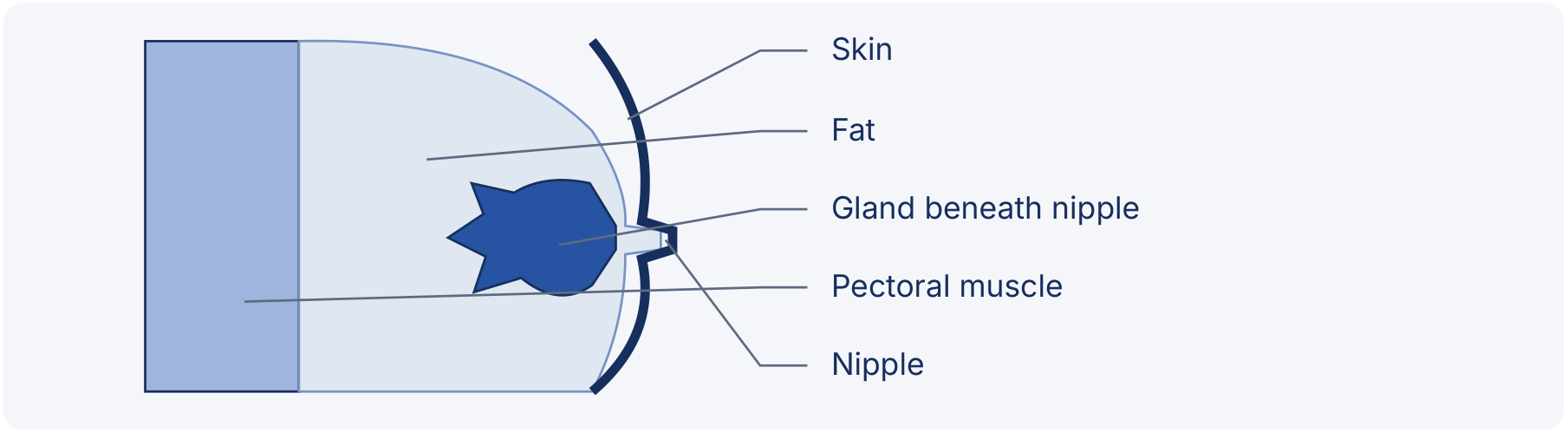
Conceptual side section, not to scale. The gland lies beneath the nipple and in front of the pectoral muscle. Illustrations cannot establish a diagnosis.
Fat-predominant: pseudogynecomastia
Gland-predominant: gynecomastia
Both may coexist; excess skin is assessed separately.
Fat, gland and skin are different
Pseudogynecomastia is fat-predominant enlargement without gland enlargement. Fat and gland enlargement may coexist, and loose skin is a separate concern. One or both sides can be affected; asymmetry is common. Exercise or weight change may affect fat, but exercise alone does not remove persistent glandular tissue.
Why it happens
Hormonal changes during puberty or aging, medicines, anabolic steroids or other substances, and some medical conditions can contribute. Excess weight may increase the fat component; not every enlarged chest is caused by obesity or gland growth.
When surgery may fit
Consider the underlying cause, observation or appropriate medical treatment first. Surgery may help persistent symptoms or an unwanted contour. Good health, stable weight, not smoking and realistic expectations support planning; there is no universal “ideal weight” cutoff.
Adolescent gynecomastia may resolve without treatment. Follow-up, stable growth, decision-making maturity and supportive discussion matter; parental involvement and consent are arranged when appropriate. Continued development may mean another procedure later. Emotional support can help with distress, but surgery cannot guarantee greater confidence.
Arrange assessment before cosmetic treatment
A new hard lump, nipple discharge or retraction, skin dimpling, or a new one-sided change needs medical assessment. Do not assume every change is benign or that gynecomastia itself means cancer.
02 · Before surgery
Consultation & preparation
A careful history and examination help distinguish fat, gland and other causes of a chest change. Be open about symptoms, medicines and substance use; the discussion should be respectful and nonjudgmental.
Come ready to discuss
- When enlargement began, its duration and growth, pain, and whether one or both sides are affected; your goals and concerns.
- Medical and endocrine history, relevant family history, previous operations, allergies, blood clots and healing problems.
- All prescribed medicines, supplements and hormones; prescribed or recreational anabolic steroids; alcohol, nicotine, vaping and other drug use.
Your clinician will assess
- Chest fat, gland, skin quality and nipple/areola position; photographs may be taken for your medical record.
- Whether blood or hormone tests, imaging or biopsy are indicated to investigate the cause or exclude another condition. CT or MRI is not routine for everyone.
- Whether an endocrinology or other referral, observation or medical treatment should precede surgery; bring relevant records.
Prepare with your surgical team
Testing and medical evaluation are individualized. Review anticoagulants, aspirin, anti-inflammatory medicines and herbs that can increase bleeding. Do not stop or change prescribed treatment without the prescriber’s agreement. If a medicine or substance contributes to enlargement, discuss alternatives or a medically supervised withdrawal plan where needed; do not make abrupt blanket changes.
- Individual testing
- Medicine review
- Ride & adult support
- Safe surgical setting
Follow the team’s nicotine-cessation advice and written instructions for fasting, washing and medicines on the day. Ask about the planned anesthesia, expected scars, likely results and your individual risks before giving consent.
Plan a safe setting and practical support
Use an appropriately licensed surgical setting with qualified anesthesia care. Local anesthesia with intravenous sedation or general anesthesia may be selected according to the plan and your health. Arrange a ride and an adult for at least the first night, plus help at home. Discharge may be the same day or after an overnight stay; it is not identical for everyone.
03 · On the day
Your individualized procedure
The balance of fat, firm gland, skin elasticity and nipple/areola position determines the operation. The areola is the pigmented circle around the nipple; its size and position are addressed only when needed.
Anesthesia and the agreed plan
Your surgeon and anesthesia clinician select local anesthesia with intravenous sedation or general anesthesia for your needs. Markings and the incision plan are individualized.
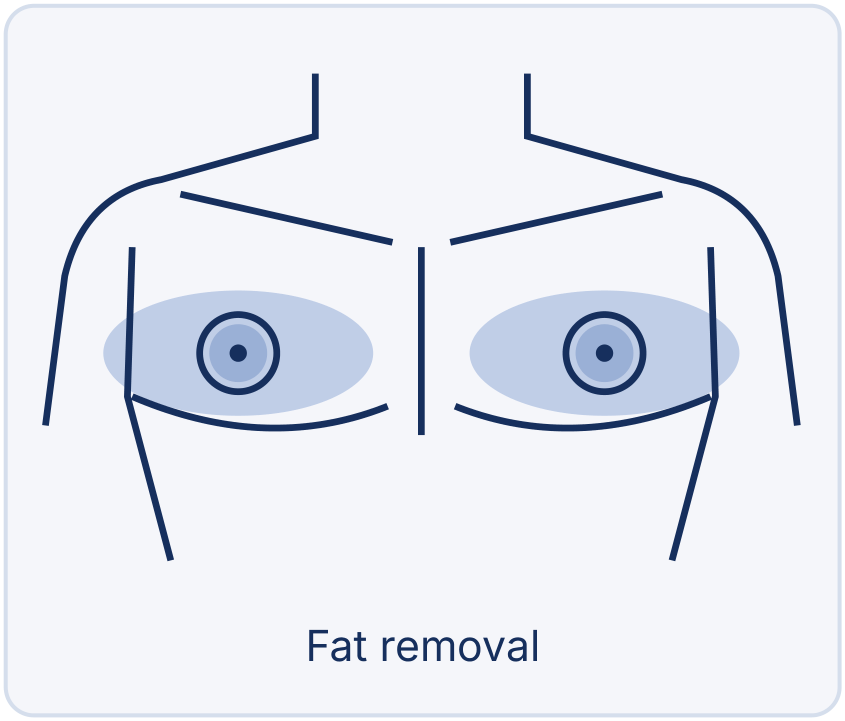
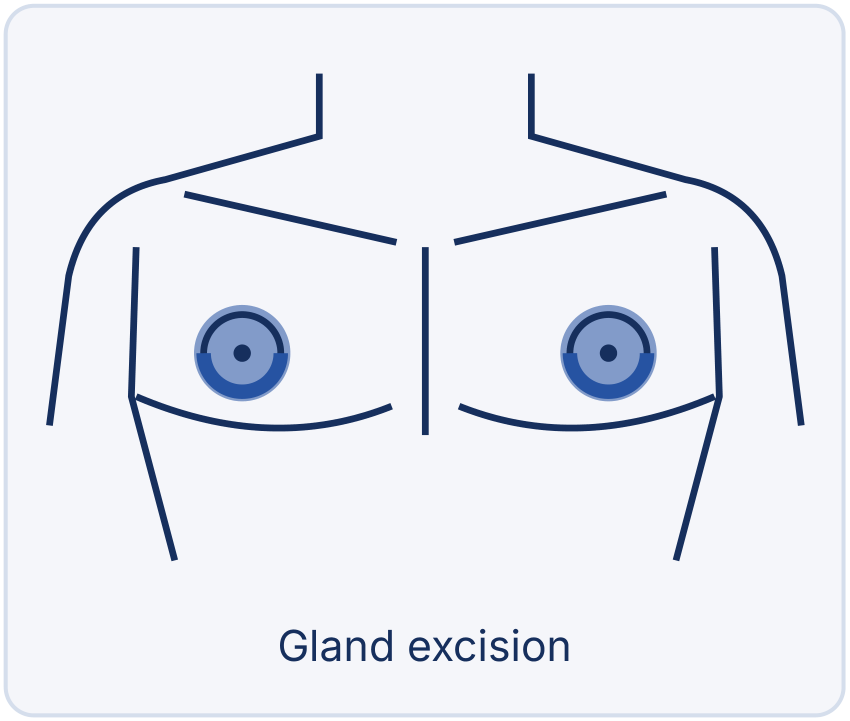
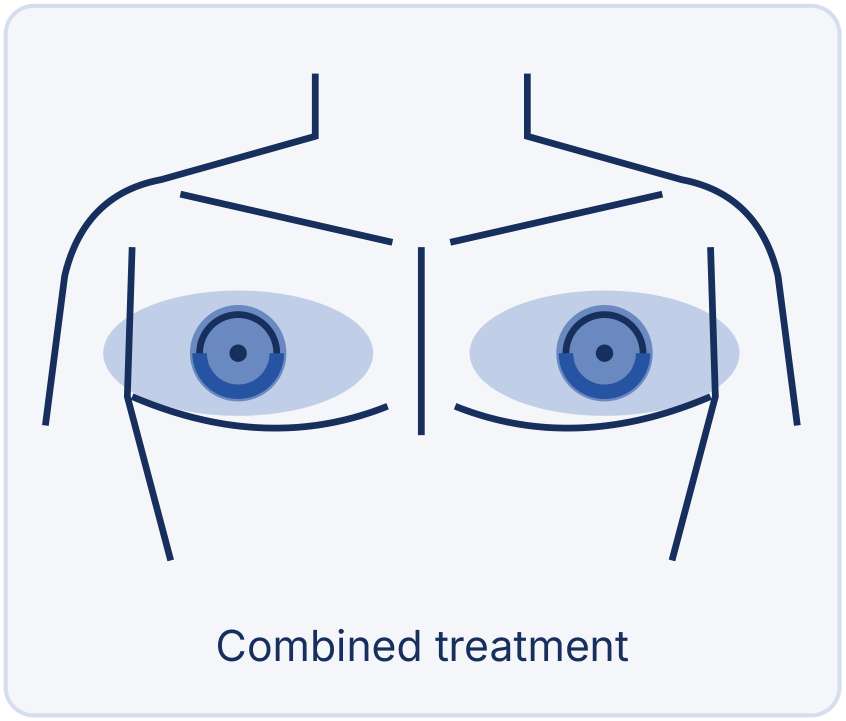
Conceptual front-view maps, not operative instructions. Shading marks selected fat or gland; bold lower semicircles show a possible incision along the lower areolar border, not removal of the whole areola. Your incision plan may differ; skin reduction can require longer scars.
Liposuction for selected fatty fullness
Liposuction may be suitable when fat predominates and skin elasticity is good. A thin cannula removes fat from the subcutaneous layer, above the pectoral muscle. Liposuction does not remove the breast gland tissue itself and is not usually enough for dense gland.
Excision of gland and, when needed, skin
Firmer gland can be removed through an individualized incision, often along the lower areolar border when the amount is limited. Excess skin needs a different or more extensive incision plan. Areola reduction or nipple/areola repositioning is selected case by case; a full ring incision is not necessary for every patient. Fat removal and gland excision can be combined.
Closure and early changes
Sutures, surgical tape or skin adhesive may close the incisions. Dressings, a support garment and temporary drains are used selectively. The pectoral muscle is not routinely removed or tightened, and implants are not part of this reduction treatment.
Scars and contour are individual
Significant skin redundancy may require longer visible scars. Scars are permanent although they usually fade. Swelling obscures the early contour; the result develops over months. Contour depressions, asymmetry or a need for revision remain possible.
04 · After surgery
Recovery & results
Recovery is guided by your operation and healing, not a fixed deadline. Ask for written instructions and keep your follow-up appointments.
After surgery
Dressings, support and discharge instructions.
Early healing
Wound care, gentle activity and review.
Over the following months
Swelling settles and the contour becomes clearer.
Longer term
Scars mature; changes in weight or hormones can affect the chest.
Care at home
- Use dressings and any support garment only as directed. Ask when to change or remove them and when you may bathe.
- If drains are used, follow care and output-recording instructions. Do not remove drains yourself; ask when drains or stitches will be removed.
- Clarify wound care, prescribed medicines, review dates and the after-hours contact number.
Movement and daily life
- Protect incisions from tension, rubbing and excessive movement.
- Gentle walking and prescribed clot-prevention measures are important; recovery does not mean prolonged bed rest.
- Avoid heavy lifting and chest exercise until cleared. Ask individually about work, driving, sport and other activity.
What to expect
Tenderness, swelling and bruising are common early and can last weeks. The contour continues to settle over months, with timing varying between patients. Some scars sit within natural contours, but they are not invisible. No result or perfect symmetry is guaranteed; revision may be needed.
Stable weight helps maintain the result without guaranteeing it. Enlargement can recur if an underlying cause persists; hormonal or weight changes can alter the chest. Discuss contributing medicines with the prescriber rather than stopping treatment yourself. A new lump or nipple discharge after healing still needs medical review.
When to seek help
Rapid painful swelling on one side or heavy bleeding: contact the surgical team urgently. Fever, increasing redness or drainage, worsening pain or wound opening: seek prompt clinical advice. Shortness of breath, chest pain or an unusual heartbeat: seek emergency medical care immediately.
05 · Informed decisions
Risks & safety
Consent is a discussion, not just a signature. Weigh the possible benefits against the risks and ask about the risks specific to your health, anatomy and technique.
- Allergic or other reactions to tape, sutures, dressings, glue, topical preparations or injected agents.
- Anesthesia complications.
- Bleeding or hematoma (a collection of blood).
- Blood clots.
- Chest or breast asymmetry.
- Contour and shape irregularities, including depressions.
- Temporary or permanent changes in nipple or chest sensation.
- Temporary or permanent injury to deeper nerves, blood vessels, muscles or lungs; the risk depends on anatomy and technique.
- Deep vein thrombosis (DVT), cardiac and pulmonary complications.
- Fat necrosis (death of fatty tissue).
- Seroma (a collection of fluid).
- Infection.
- Persistent pain.
- Poor wound healing.
- A need for revision surgery.
- Unfavorable or visible permanent scars.
Understand your own risk
These are possible complications, not predictions that each will occur. Ask how your team reduces risk, what additional risks apply to you and what treatment or further surgery might be needed. Results and permanence cannot be guaranteed.
Before agreeing, make sure you understand alternatives, the planned incisions, expected recovery, warning signs and who to contact. You should have time to ask questions and make an informed choice.
06 · Planning ahead
Cost & choosing your surgeon
Request a written, individualized estimate. Costs depend on the treatment needed, the surgeon, anesthesia, the facility and the location, not a standard price for every chest.
- Tests & assessment
- Medicines & garment
- Surgeon & anesthesia
- Facility & follow-up
Know what is included
- Surgeon’s fee and the proposed fat, gland and/or skin treatment.
- Anesthesia and hospital or surgical-facility fees.
- Medical assessment, tests, garments and prescribed medicines.
- Follow-up appointments and the policy for complications or revision; ask which costs would be additional.
Coverage is individual
Confirm the terms of your own policy directly with the insurer before booking. Medical investigation and surgery may be treated differently. Ask about any approval or documentation required; do not assume that all care is covered or that it is always excluded.
Choose expertise, not only a fee
Choose a qualified plastic surgeon experienced in male breast reduction. Ask about training, appropriate licensing and experience distinguishing gland enlargement from fat or another cause. The assessment should address why enlargement occurred, not only how the chest looks.
Questions worth asking
- Which technique fits my fat, gland and skin, and why?
- Where will surgery take place, with what anesthesia and monitoring?
- What scars, asymmetry or contour limitations should I expect?
- Who provides follow-up, after-hours advice and care if a complication occurs?
Ask to discuss representative results with realistic limitations. An appropriate licensed facility, qualified anesthesia care, clear communication and a reliable follow-up plan matter as much as price. Take time to decide without pressure.
Book a consultation
Let’s discuss your goals
- Phone +961 1 746345
- WhatsApp +9613307854
- Email psi@psi-lb.com
- Address 63 Souraty Street, Hamra, Nassif Bldg, 1st Floor, Beirut, Lebanon
Bring your medication list, relevant medical records and your questions. Ask how to reach the surgical team after hours; routine messages are not an emergency service.
This guide provides general education, not a diagnosis, a personalized treatment plan or a guarantee of results. It does not replace an in-person assessment with a qualified plastic surgeon. Follow the instructions of your own clinical team.