
Liposuction
Lipoplasty
Everything you need to know, from your first consultation to your final result.
01 · The basics
Understanding liposuction
Liposuction (lipoplasty) removes localized deposits of subcutaneous fat (fat beneath the skin) to reshape the body’s contours and proportions. It does not remove visceral fat around the internal organs.
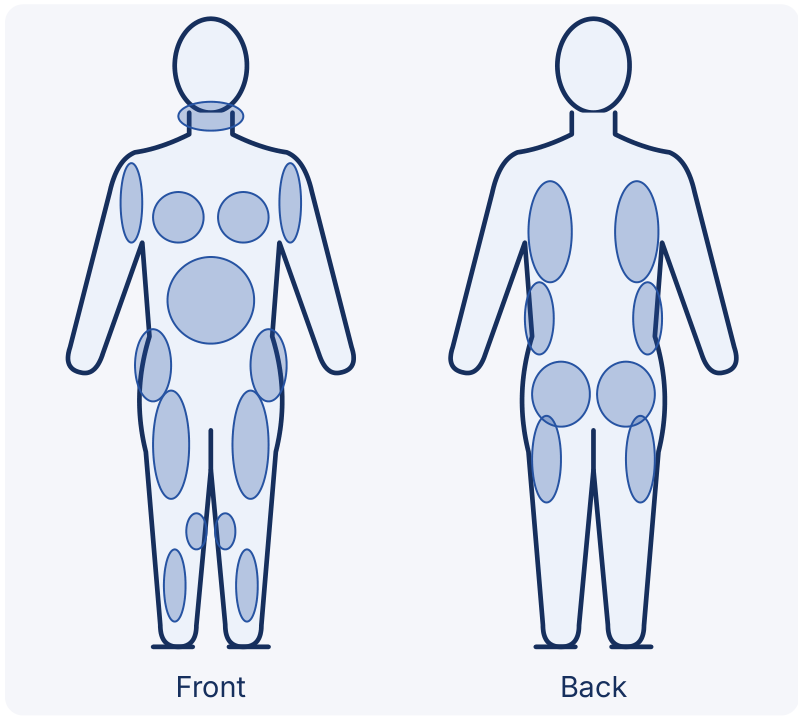
Shaded areas are illustrative, not a treatment plan suitable for everyone.
Areas that may be treated
- Thighs
- Hips and buttocks
- Abdomen and waist
- Upper arms
- Back
- Inner knees
- Chest area
- Cheeks, chin and neck
- Calves and ankles
Could it be right for you?
Liposuction may suit women and men with fat deposits that resist diet and exercise. Favorable candidates are healthy, nonsmoking adults near a healthy, stable weight, with firm, elastic skin, good muscle tone and realistic goals. A clinical examination determines whether it is appropriate for you.
Body contouring, not weight loss
Liposuction is not a treatment for obesity or a weight-loss method. It does not replace a balanced diet and exercise, and does not effectively correct cellulite or loose skin. Skin elasticity matters. When appropriate for your situation, it may be combined with a facelift, breast reduction or tummy tuck.
02 · Before surgery
Consultation & preparation
Speak openly about your expectations, health and concerns. Some anxiety is natural; asking questions is part of preparing for surgery.
Come ready to discuss
- Your goals and the areas that concern you
- Medical conditions, drug allergies and treatments
- All medicines, vitamins and supplements; alcohol, tobacco and other substances
- Previous operations
What your surgeon assesses
- Your health, existing conditions and risk factors
- Fat distribution and skin elasticity
- Photographs for your record, options and the proposed plan
- Anesthesia, possible results and complications
Individualized preparation
- Lab tests or medical evaluation
- Review your medicines
- Stop smoking as instructed
- Review products that increase bleeding
- Arrange transport and overnight support
Tests and medication adjustments depend on your situation. Aspirin, anti-inflammatory medicines and herbal supplements may increase bleeding. Do not stop or change any prescribed medicine unless your surgeon instructs you to do so.
Where surgery takes place and who can help
Surgery should take place in an authorized, appropriately equipped surgical facility, whether office-based, an outpatient center or a hospital. Arrange a ride to and from surgery and someone to stay with you for at least the first night. Ask for practical instructions specific to your operation.
Ask about the technique, anesthesia and recovery; discuss your concerns before giving consent.
03 · On the day
The procedure, step by step
The technique, treatment areas and anesthesia are chosen according to your anatomy, health and the extent of treatment.
Anesthesia
Local anesthesia, intravenous sedation or general anesthesia may be used. Your team recommends an option suited to your comfort and safety.
Access and fat removal
Small, discreet incisions allow a solution containing diluted local anesthetic to be infused to reduce bleeding and tissue trauma. A cannula (a thin, hollow tube) is introduced into the subcutaneous fat. Controlled back-and-forth movements loosen the fat, which is removed by suction or a syringe attached to the cannula.
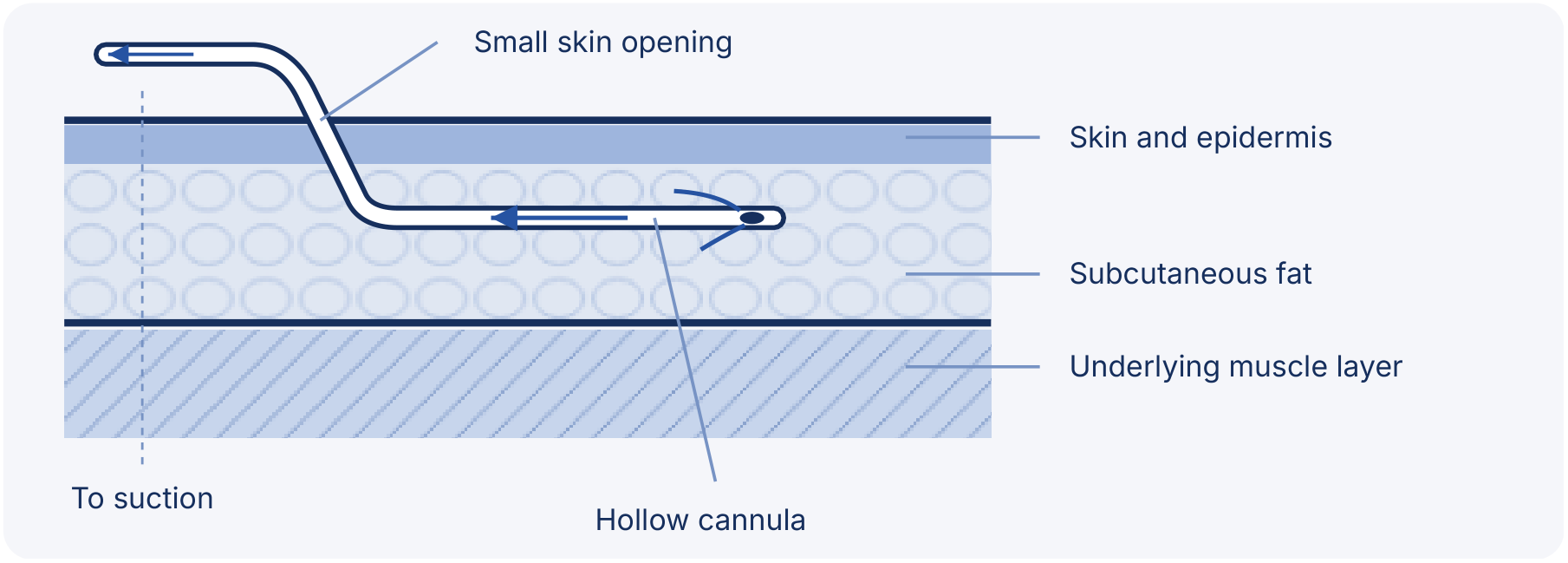
Schematic cross-section, not to scale. The cannula tip stays in the subcutaneous fat, above the muscle layer; arrows show the path of fat toward suction.
The contour emerges
The improvement becomes clearer as swelling and fluid retention subside. The early appearance is not the settled result.
What the procedure does not do
Liposuction does not remove excess skin or repair muscles. This diagram explains the procedure without promising an outcome or representing every technical variation.


04 · After surgery
Recovery & results
Aftercare, the duration of compression garment use and the return to exercise are individualized. Swelling may take several months to resolve completely.
Immediately
Protection & compression
Dressings, an elastic bandage or a compression garment may support treated areas and help limit swelling.
Early healing
Care & follow-up
Small temporary drains may remove blood or fluid. Follow your wound-care and medication instructions.
Following months
Contours become clearer
Swelling and fluid retention gradually decrease, making the contours easier to assess.
Long term
Stability & health
A stable weight, balanced diet and physical activity help maintain the result.
General stages, not fixed deadlines. Your health and operation determine your individual recovery.
Your discharge instructions
- Caring for incisions and any drains
- Prescribed topical or oral medicines to aid healing and help prevent infection
- Changes to watch for at the surgical site or in your general health; contact details and follow-up appointments
Practical questions
- Where will I go after surgery, and what medicines will I receive?
- When are dressings, drains or stitches removed, if needed?
- How should I bathe, and how long should I wear compression?
- When can I resume activities and exercise, and return for review?
Protect incisions from tension, rubbing and excessive movement while healing. Follow your own instructions rather than a standard calendar.
Results without guarantees
Results may be long lasting, but cannot be guaranteed. Remaining fat cells can enlarge with weight gain, and aging may reduce skin firmness. Revision surgery or a separate procedure to remove skin may be needed: liposuction does not correct skin laxity.
05 · An informed decision
Risks & safety
The decision is personal: weigh the expected benefits against the risks. Informed consent confirms that you understand the operation and its possible complications.
Surgery & anesthesia
- Anesthesia risks
- Bleeding, bruising and infection
- Deep vein thrombosis (blood clots); heart or lung complications
Tissues & healing
- Injury to deeper structures: nerves, blood vessels, muscles, lungs or abdominal organs
- Fluid accumulation and poor wound healing
- Swelling, which may persist
Skin & appearance
- Changes in sensation that may persist
- Irregular pigmentation
- Contour irregularities or asymmetry
- Rippling or loose skin, worsening cellulite
- Possible revision surgery
Technical risks
- Cannula breakage
- Burns or thermal injury if an ultrasound-assisted technique is used
General complications
- Fat embolism: fat blocking a blood vessel, particularly in the lungs
- Fluid shifts that may affect the kidneys, heart or lungs
- Lidocaine toxicity: serious effects of this local anesthetic on the heart or nervous system
Large volumes and multiple areas
These require appropriate planning, facilities and monitoring; combining procedures may increase risk. Safety depends on your individual situation, not a universal amount of fat that can be removed.
Discuss all these risks and those specific to you with your surgeon before consenting. Ask how complications are prevented, recognized and managed.
06 · Planning ahead
Cost & choosing your surgeon
Cost varies with the surgeon’s experience, technique, extent of treatment and practice location. Ask for a personalized estimate and whether payment plans are available.
What the estimate may include
- Surgeon’s fee
- Anesthesia
- Clinic or hospital
- Medical tests
- Compression garment and medicines
Check the total
Ask what is included, especially follow-up and any additional care or procedures. Check your insurance policy directly for exclusions and possible coverage: do not assume that cosmetic surgery or its complications are covered.
More than a fee
Experience, clear communication and trust matter as much as price. Choose a qualified, experienced plastic surgeon and ask what results are realistic for your situation.
Criteria to check
- A qualified plastic surgeon specializing in plastic, reconstructive and aesthetic surgery
- Complete surgical training at a recognized institution
- Experience with liposuction and examples of results
- An authorized facility equipped to protect your safety
- Clear answers to your questions and explanations of the risks
Feel free to ask about your surgeon’s training and experience. A practitioner you can trust takes the time to answer.
Book your consultation
Let’s talk about your goals
- Phone +961 1 746345
- WhatsApp +9613307854
- Email psi@psi-lb.com
- Address 63 Souraty Street, Hamra, Nassif Bldg, 1st Floor, Beirut, Lebanon
This guide is for general educational purposes only. It makes no promise or guarantee about the outcome of any procedure and is not a substitute for a thorough, in-person consultation with a qualified plastic surgeon.