
Breast Implant Removal
Your reasons, capsule options and an individualized plan for care.
01 · Patient guide · Informed choices
The basics & your choices
Explantation removes a breast implant. Whether to remove surrounding scar tissue is a separate decision, based on findings, health, goals and the risks of additional surgery.
Why consider removal?
Reasons include a change in personal preference, pain, hardening from capsular contracture, confirmed or suspected rupture, displacement, infection or another device complication. Pain and changes need assessment because they can have more than one cause. You may wish to remove implants even without a complication; choosing to discuss removal does not require proving that your concerns are serious enough.
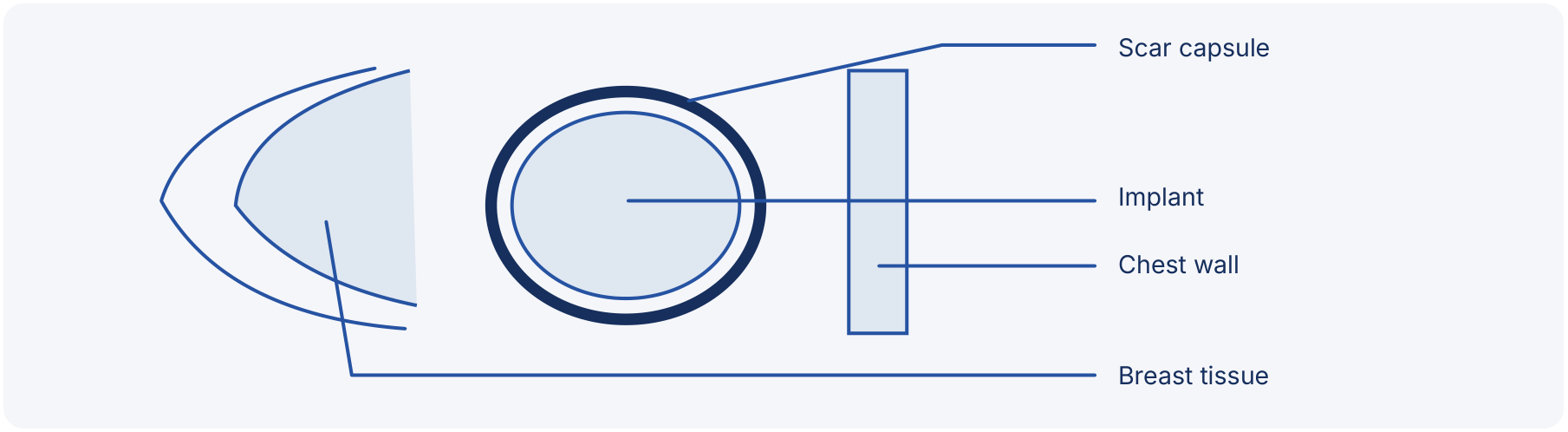
Simplified schematic, not to scale or an operative plan. Individual anatomy varies.
What is the capsule?
The capsule is scar tissue your body forms around an implant. Its presence alone does not mean disease, toxicity or cancer. It can become thickened, tight or abnormal, but it is not automatically necessary to remove every part. Leaving some or all of a clinically appropriate capsule can avoid extra dissection; explain any concern about retained tissue during shared decision-making.
Appearance and optional next steps
After removal the breast can look smaller, flatter, looser, indented or less symmetrical. Existing skin stretch, implant size and your remaining tissue affect the change. Removal alone is valid. A breast lift and/or selected fat grafting may be discussed, either together or staged after healing; neither is required or a promise of restoring your earlier breasts. Fat grafting needs suitable donor tissue and has its own risks and variable retention.
The FDA does not recommend routine preventive removal in people without symptoms solely because of concern about BIA-ALCL, a rare implant-associated lymphoma. This is not a ban on removal: your preferences and individual risks still deserve discussion. If you keep implants for now, continue recommended monitoring.
02 · Patient guide · Informed choices
Consultation & preparation
A useful consultation begins with your concerns and existing implant records, not a promise that everyone needs the same operation.
Bring records and a symptom history
Bring implant cards, manufacturer and model details, placement dates, earlier operative reports and breast imaging. Record when symptoms began, whether one or both sides changed, and previous infection, radiation, biopsies or revisions. If records are missing, ask the original facility; uncertainty about the device should be documented rather than guessed.
Assessment before an elective plan
The surgeon examines the breasts, skin, scars, nipple position and implant pocket, reviews your health, and may suggest ultrasound, MRI or other testing according to the findings. New late swelling, a lump, persistent fluid or new pain needs prompt assessment. Imaging and appropriate sampling of peri-implant fluid or tissue may be necessary before elective removal. Do not bypass this workup: an implant-associated cancer diagnosis changes the operation and specialist care needed.
Prepare with the whole team
List all medicines, supplements, allergies, nicotine or vaping, alcohol use and medical conditions, including bleeding or clotting problems. Discuss pregnancy or breastfeeding plans and emotional priorities. Follow the team’s nicotine-cessation, nutrition, washing and fasting instructions. Tests and anesthesia review depend on your health and procedure; not everyone needs the same investigations.
Do not stop a prescribed anticoagulant or any other medicine on your own. The surgeon, anesthesia team and prescriber must agree on changes. Arrange a ride home after anesthesia or sedation, a responsible adult for early support and childcare or help with lifting. Confirm the monitored recovery setting and the after-hours contact plan.
Ask whether additional shaping should wait, what would change the surgical plan, and whether a second opinion would help. You can take time to understand alternatives without pressure.
03 · Patient guide · Informed choices
Removal & capsule options
Removal alone, partial capsulectomy, total capsulectomy and oncologic en bloc resection describe different operations. More extensive dissection is not automatically better or safer.
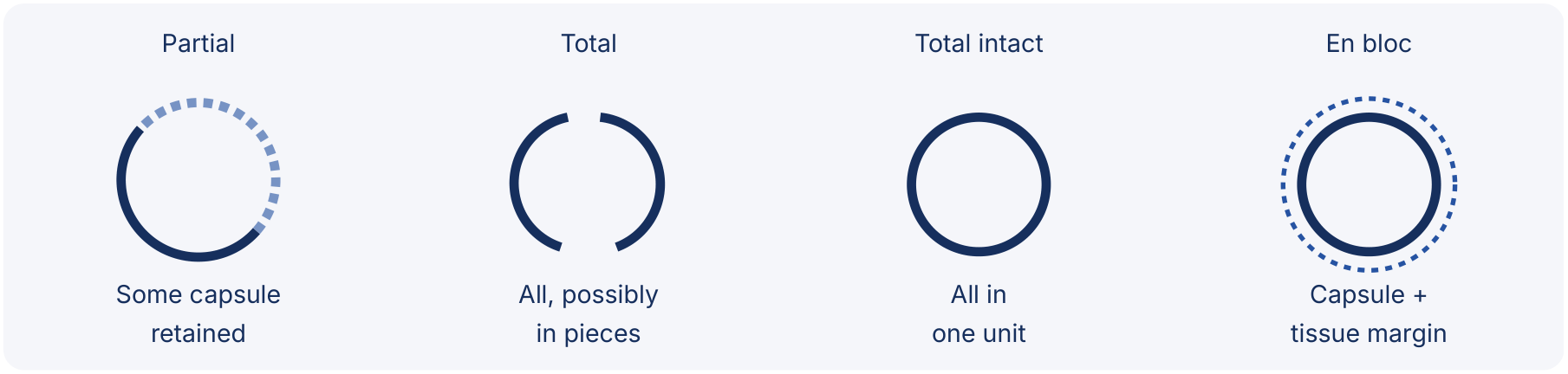
Simplified schematic, not to scale or an operative plan. Individual anatomy varies. These are definitions, not recommendations for every patient. Dashed outer ring: the uninvolved tissue margin in oncologic en bloc resection.
Use precise terms
Partial capsulectomy: some capsule is removed and some remains. Total capsulectomy: all capsule is removed, possibly in pieces. Total intact capsulectomy: all capsule is removed as one unit. It is not the same as en bloc. En bloc: oncologic removal of the capsule with a margin of uninvolved tissue for suspected or confirmed implant-associated cancer after appropriate workup, as defined by BSCC.
En bloc is not automatically required for reported breast implant illness or for every rupture. Contracture, rupture or capsule abnormalities may justify some or all capsule removal. Your surgeon should explain the indication and the balance between removing affected tissue and avoiding injury, particularly where the capsule adheres to the chest wall.

Illustrative access only; not a lift
Simplified schematic, not to scale or an operative plan. Individual anatomy varies.
Access, removal and closure
Anesthesia is selected with the anesthesia team and suitable monitoring. Access may reuse a prior scar or use the fold beneath the breast; its length depends on the required operation. Removing an implant is not automatically a breast lift and does not routinely detach the whole nipple–areola complex. The device and planned capsule tissue are removed, findings documented and specimens assessed as indicated. Appropriate cancer testing must be planned, not replaced by a generic specimen request.
Bleeding is controlled and the wound closed in layers. A drain or support garment may be used if indicated. The surgeon should discuss contingencies, including leaving an adherent capsule portion when appropriate for safety, and explain any additional shaping separately before consent.
04 · Patient guide · Informed choices
Recovery & follow-up
Your recovery depends on the amount of dissection, any additional procedures and your health. Follow a written plan rather than a universal timetable.
Early care at home
Expect some soreness, swelling and bruising; ask what is usual for your specific operation and what needs a call. Follow instructions for dressings, bathing, prescribed pain relief and any support bra. If drains are used, learn how to care for them, record output and arrange removal by the team. Do not remove drains or manipulate healing pockets yourself.
Activity and practical support
Gentle movement and any prescribed clot-prevention measures are individualized. Ask about sleeping position, arm movement, lifting children, work, driving, exercise and travel. Resume strenuous activities only when cleared. Driving requires safe movement and freedom from impairing medicines as well as the team’s approval. Arrange help that matches your responsibilities rather than assuming a short recovery.
Results take time
Swelling changes the early appearance; skin and scars settle over months at different rates. Permanent scars, loose skin or contour differences can remain. A staged lift or fat grafting may be reconsidered once healing is clearer, but no further surgery is obligatory and correction cannot be guaranteed. Keep follow-up visits even if you feel well.
Contact the surgical team urgently for rapid one-sided swelling, increasing pain, fever, spreading redness, drainage or an opening wound. Seek emergency care for difficulty breathing, chest pain or collapse. Do not wait for a routine appointment or assume new symptoms are normal healing.
Keep a long-term record
Implants are not lifetime devices. Retain the operative report, implant identification, capsule/pathology results and advice about any retained tissue or silicone. Continue breast-health screening and symptom assessment. Until removal, monitor existing devices; any remaining or replacement implant needs its own FDA/device-informed monitoring plan. Removal or capsulectomy is not a guarantee against every later breast or capsule problem.
05 · Patient guide · Informed choices
Risks & informed consent
Removal may address a device problem or meet a personal preference, but it cannot guarantee symptom relief, a particular shape or freedom from future problems.
Surgery and anesthesia risks
Possible complications include bleeding or hematoma, infection, fluid collection (seroma), delayed or poor wound healing, unfavorable permanent scars, skin or tissue loss, persistent pain, and anesthesia-related problems. Blood clots and cardiac or pulmonary complications can occur. Your personal history, earlier operations and the extent of treatment affect risk; this list is not exhaustive.
Breast, nerves and chest wall
Temporary or permanent changes in nipple or breast sensation, nerve injury, asymmetry, flattening, contour loss, indentations and dissatisfaction are possible. A lift or fat grafting adds separate risks. Capsule dissection near muscle and ribs can cause bleeding, chest-wall injury or pneumothorax, in which air around a lung can impair breathing. Pursuing a complete intact specimen at any cost is not a safety goal.
Reported systemic symptoms
Some people report fatigue, brain fog, muscle or joint pain and other symptoms described as breast implant illness. Symptoms deserve respectful assessment, including evaluation for other causes. Their cause and relationship to implants are not fully understood. Some people improve after removal; improvement or resolution is not guaranteed. Removal is not a proven universal detoxification treatment or cure for autoimmune disease, and complete capsule removal is not established as necessary for symptom improvement without another indication.
BSCC notes that whether capsulectomy prevents future implant-associated cancer is unknown. Any persistent or new breast change still needs assessment after surgery. Discuss the possibility of revision and the limits of correcting contour, pain or systemic symptoms before deciding.
Consent should reflect the operation actually planned, its alternatives and your preferences, not a promise that all capsules are dangerous or that one technique eliminates every risk.
06 · Patient guide · Informed choices
Choosing your surgeon & cost
Choose a qualified, experienced plastic surgeon and a safe care pathway. Clear explanations and accessible follow-up matter more than a marketing label or the lowest quote.
Verify relevant experience
Ask about appropriate qualifications, authorization to practice and experience with implant removal, capsule surgery and your specific history. Prior reconstruction, radiation, rupture or suspected cancer may require additional expertise. Confirm a suitable licensed facility, qualified anesthesia care, monitoring, emergency arrangements and a clear route to hospital care if needed. No professional membership or certification is claimed by this guide.
Ask for a written, itemized estimate
Clarify surgeon and anesthesia fees, facility or admission charges, imaging, laboratory tests, fluid sampling, pathology, drains, dressings, prescribed medicines and follow-up. If a lift, fat grafting, replacement implant or staged procedure is considered, obtain a separate description and estimate rather than assuming it is included. Ask how unexpected findings, admission, complications and revision would be billed.
No fees, financing arrangements, specific devices or local availability are promised here. Check your own insurer and policy directly about removal, capsule surgery, diagnostic testing, optional shaping and complications. Request written answers about exclusions, approval requirements and your out-of-pocket responsibilities. Do not assume that a medical reason for removal guarantees reimbursement.
Questions that clarify the decision
Why remove none, part or all of my capsule? What findings would change that plan? Is cancer workup needed first? What does the proposed term mean? What shape changes should I expect without a lift? Who reviews results and responds after hours? What help and time away from work or caring duties should I arrange?
Take your plan home, review the alternatives and seek a second opinion if helpful. Keeping implants with appropriate monitoring, removing them without extra shaping, or choosing a staged approach can each be reasonable depending on your assessment. Your priorities may change; the decision should remain informed and free of pressure.
Patient guide · Informed choices
Let’s talk about your priorities
- Phone +961 1 746345
- WhatsApp +9613307854
- Email psi@psi-lb.com
- Address 63 Souraty Street, Hamra, Nassif Bldg, 1st Floor, Beirut, Lebanon
Bring this guide, your questions and relevant records to the consultation. Ask for a personal plan, written aftercare and a clear emergency contact. Not every technique described is offered or locally available.
This guide provides general education only, not individualized medical advice or a treatment plan. It makes no representations, warranties or guarantees about outcomes and does not replace a thorough, in-person consultation with a qualified, experienced plastic surgeon. Follow your treating team’s instructions.
Sources and further reading
FDA · Implant-associated lymphoma (opens in a new tab) · BSCC · Capsule definitions (opens in a new tab) · FDA · Reported systemic symptoms (opens in a new tab) · FDA · Risks and removal (opens in a new tab)