
Face Lift
A personal, restorative approach. Understand your options, preparation and recovery.
01 · The basics
Understanding a facelift
A facelift, or rhytidectomy, repositions sagging facial tissues. The face, lower face and neck may be treated, depending on the extent of the operation.
What may improve
- Sagging cheeks, jowls and loss of jawline definition.
- Loose neck skin and selected fat deposits beneath the chin or jaw.
- Some facial folds may soften, but deep nasolabial folds and eyelid creases are not reliably erased.
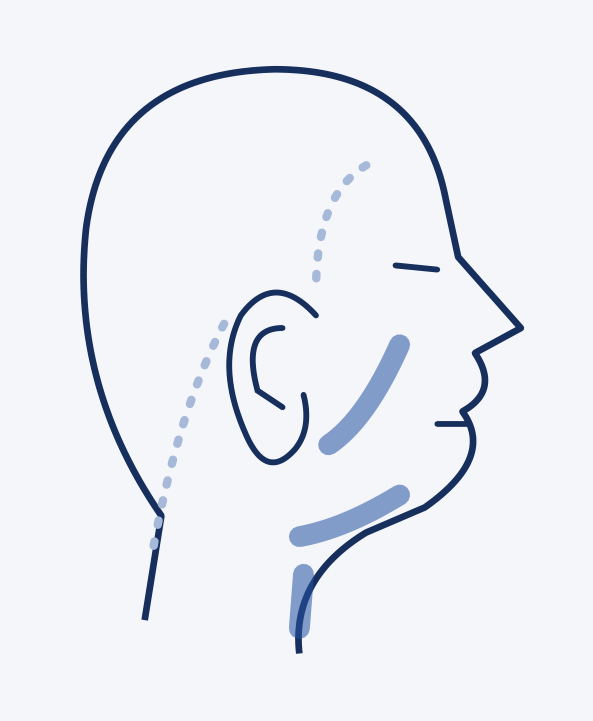
Schematic treatment areas only: not a before-and-after image or a promise of correction.
What it cannot promise
A restorative facelift aims to respect your identity; it does not stop aging or guarantee greater confidence. It does not directly treat fine wrinkles, sun damage or pigment changes. Lost volume is not automatically restored by lifting alone.
Who may be a candidate?
Adults of any gender may be considered; there is no fixed age. Good general health, no nicotine use and realistic expectations are important. Stable weight can help. Medical conditions that affect healing or surgical safety require review.
Other options are individual, not a package
Brow lift, eyelid surgery, a separate neck lift, facial implants, fat transfer, fillers or resurfacing may be considered for specific goals. Volume augmentation is optional. Nonsurgical treatments can complement care, but do not produce the same operative lifting effect.
02 · Before surgery
Consultation & preparation
Explain what you hope to change. A useful consultation covers your health, facial anatomy, alternatives and a realistic, individualized surgical plan.
Come ready to discuss
- Goals; full medical history, allergies and previous operations.
- Earlier facial surgery, fillers, botulinum toxin and other cosmetic treatments.
- All medicines, vitamins, herbs, nicotine and alcohol use.
- Blood pressure, bleeding or clotting history and conditions affecting healing.
What the surgeon assesses
- Facial bones, fat distribution, skin quality and laxity; examination and photographs.
- Your health, risk factors, alternatives, expected limits and possible additional procedures.
- Anesthesia options, complications, recovery and follow-up.
- Medical review
- Medicine review
- Nicotine cessation
- Ride & adult support
Preparation is individualized
Tests or medical evaluation may be needed, including blood-pressure control. Stop nicotine as directed by your team. Review aspirin, anti-inflammatory medicines, herbs, anticoagulants and hormones. Do not stop any prescribed treatment without coordination with its prescriber.
Your team’s instructions
Follow the specific fasting, washing and arrival instructions. Confirm a licensed surgical setting, arrange a ride to and from surgery and an adult to stay for the first night. Ask where you will recover, what medicines you will receive and how to reach the team after hours.
03 · On the day
Procedure & incisions
Incisions and the extent of deeper support are tailored to your anatomy and goals. The shortest incision is not necessarily the right approach.
Anesthesia
Intravenous sedation with local anesthesia or general anesthesia may be used, depending on the plan and your health. Your team explains the recommendation.
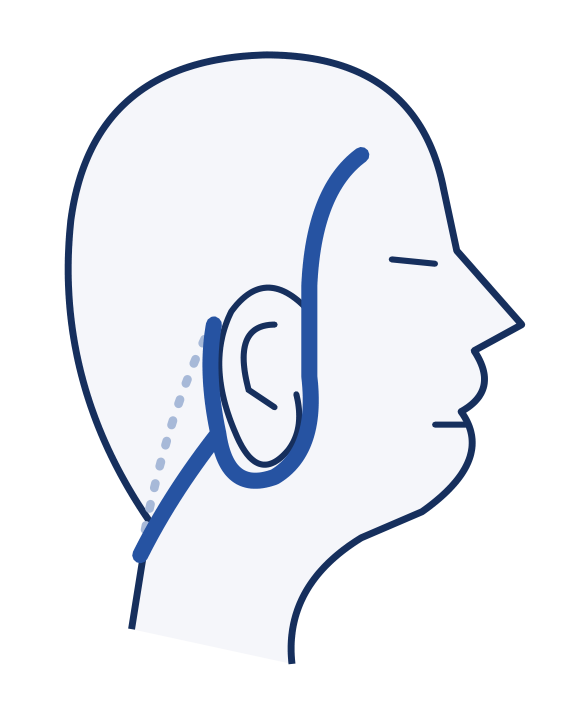
Temple hairline, front of ear, around lobe, behind ear to lower posterior scalp.
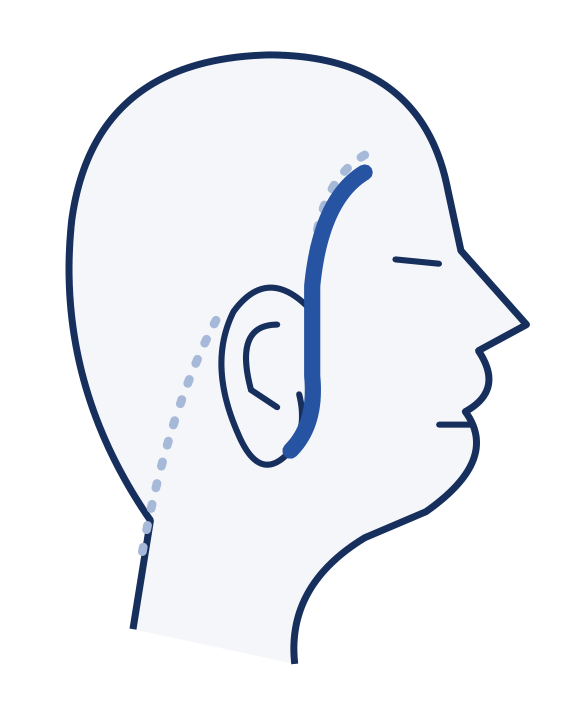
Short temple and front-of-ear incisions; no extended posterior hairline in this schematic.
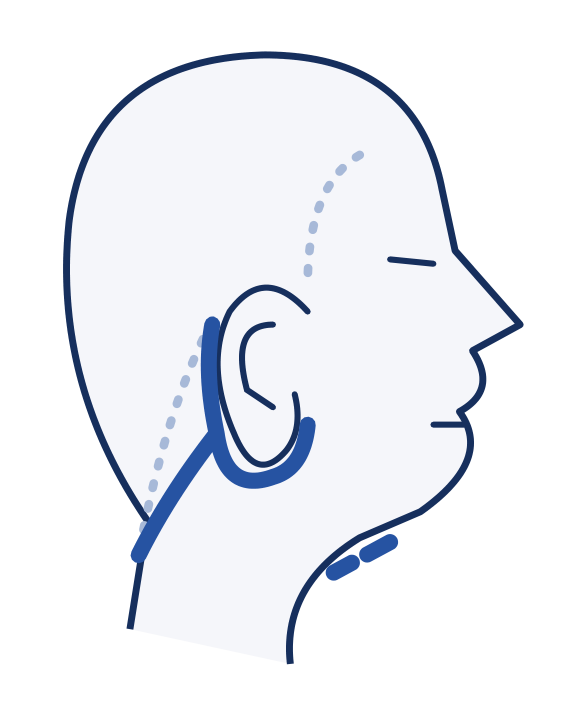
Around earlobe, behind ear to posterior scalp; separate under-chin incision if needed.

Schematic side views: not an individual incision plan. A neck lift is not identical to a traditional facelift.
Incisions & deeper repositioning
Skin is lifted and the underlying supportive layer, the superficial musculoaponeurotic system (SMAS), is repositioned as appropriate. Selected neck work may address the platysma muscle. Not every operation lifts all muscles. Fat may be contoured or redistributed; selected liposuction is optional. Skin is redraped and excess trimmed. A traditional lift may also need an under-chin incision. Limited incisions suit selected mild laxity and may have limited effects.
Closure
Absorbable or removable sutures, or skin adhesive, close the incisions. Drains and a dressing may be used. Scars are permanent; placement may help conceal them but does not guarantee invisibility.
Results develop gradually
Improvement becomes clearer as bruising and swelling settle over weeks to months. Aging continues; results are not guaranteed and revision may be needed.


04 · After surgery
Recovery & results
Healing follows your operation and health, not a fixed deadline. Your team’s written instructions take priority over general guidance.
Early care
A gentle bandage may be prescribed; drains may collect blood or fluid. Follow written wound, drain and medicine instructions. Never remove a drain yourself.
Several weeks
Bruising, swelling and numbness are common early on. Dressing, stitch and drain removal dates are individualized; early improvement is not complete recovery.
Over months
Swelling and scars continue to settle. Results vary; permanent scars remain, aging continues and another procedure may be considered.
Protect the healing tissues
- Keep your head raised; avoid bending, pressure, tension, rubbing and excessive movement at incisions. Wear front-opening clothes rather than pulling clothes over your head.
- Avoid strenuous activity until cleared. Ask when to bathe, wash your face, shampoo, cut or color hair, wear makeup, return to work and exercise.
- Use a cool compress only if your surgeon recommends it and explains how. Do not apply ice or heat directly; flap care is individualized.
- Use shade and protective clothing. Apply sunscreen to healed skin when permitted. Healthy habits may support results, but cannot guarantee lifelong maintenance.
Know when to seek help
Contact the surgical team urgently for severe one-sided face or neck pain, particularly with rapidly increasing swelling: this may indicate a hematoma. Fever, worsening redness or drainage also need prompt review. Seek emergency care for shortness of breath, chest pain or an irregular heartbeat.
05 · An informed decision
Risks & safety
Choosing surgery means weighing potential benefits against complications. Discuss every concern before giving informed consent.
Surgery & circulation
- Anesthesia risks
- Bleeding, including hematoma
- Infection
- Deep vein thrombosis and cardiac or pulmonary complications
Skin, hair & healing
- Poor wound healing and skin loss
- Temporary or permanent hair loss at incisions
- Fluid accumulation
- Unfavorable scarring
- Prolonged swelling
- Skin irregularities or discoloration
Nerves & comfort
- Facial nerve injury with temporary or permanent weakness
- Numbness or other changes in skin sensation
- Persistent pain
Appearance & further care
- Sutures surfacing through skin, visibility or irritation requiring removal
- Asymmetry, unsatisfactory scar position or visible end-of-incision deformities (“dog ears”); revision surgery may be needed
If fibrin tissue adhesive is used
It may help tissue layers adhere and reduce bleeding. Some products are plasma-derived. Ask which product is proposed, its source, benefits, allergy concerns and product-specific risks. It is not essential in every operation; no product can be guaranteed to carry zero infection risk.
This list does not cover every possible complication. Ask which risks matter most for you, how they are reduced and how complications would be treated. Consent should be an informed, personal decision, not a promise of a particular result.
06 · Planning ahead
Cost & choosing your surgeon
Choose a qualified, experienced plastic surgeon and a suitable licensed facility. Your safety, communication and comfort matter as much as the fee.
- Surgeon’s fee
- Anesthesia
- Facility
- Medical tests
- Prescribed medicines
Request a written, personalized estimate
Fees depend on the surgeon’s experience, technique, extent of treatment and practice location. No fee is quoted here. Ask about payment arrangements if needed.
Check the total
Confirm follow-up, dressings, additional procedures and possible further care or revision costs. Cosmetic surgery is often excluded from insurance. Check your own policy and insurer directly for surgery and complications; do not assume coverage or reimbursement.
Questions for your surgeon
- What qualifications and experience do you have in facelift surgery, and where will it be performed?
- Which areas will be treated, which incision pattern is proposed, and why?
- What limits, alternatives and risks apply to me? May I see relevant examples without assuming identical results?
- Who provides anesthesia and postoperative care? How can I reach the team after hours?
- What is included in the estimate, and what happens if further treatment is needed?
Take time to discuss concerns and expectations. Choose a qualified, experienced surgeon with whom you can communicate openly, not simply the lowest price.
Book your consultation
Let’s talk about your goals
- Phone +961 1 746345
- WhatsApp +9613307854
- Email psi@psi-lb.com
- Address 63 Souraty Street, Hamra, Nassif Bldg, 1st Floor, Beirut, Lebanon
This guide provides general education only, not individualized medical advice or a treatment plan. It makes no representations, warranties or guarantees about outcomes and does not replace a thorough, in-person consultation with a qualified, experienced plastic surgeon. Follow your treating team’s instructions.