
Thigh Lift
Thighplasty
A personal choice. Understand the options, preparation, recovery and limits.
01 · The basics
Understanding thigh lift
Thighplasty reduces excess skin and, in selected cases, fat along the inner or outer thighs. The aim is to improve contour, not to achieve an ideal body image.
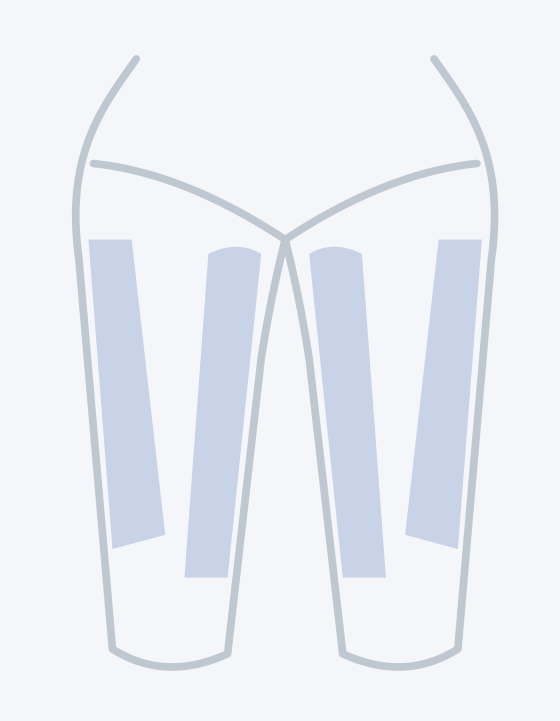
Shaded regions indicate possible treatment areas only, not an incision plan or a promised result.
What it can (and cannot) do
It is not weight-loss surgery or a fat-only treatment. It does not promise to eliminate cellulite or stretch marks, or to transform skin quality. Stretch marks on removed skin may go with it; others remain.
Where liposuction fits
If excess fat is the main concern and skin elasticity is good, liposuction alone may be considered. With poor skin elasticity, selected liposuction may accompany a lift, but does not replace removal of excess skin.
Who may be a candidate?
Healthy adults of any gender with excess inner or outer thigh skin, a stable weight, realistic expectations and a commitment to healthy habits may be considered. Being a nonsmoker is important. Conditions affecting healing or surgical risk need individual review.
A choice made for you
Your goals may be functional, aesthetic or both. Surgery is optional, not a response to pressure from others. If further weight loss is planned, discuss when your weight should be stable and how that affects the plan.
02 · Before surgery
Consultation & preparation
An open discussion of your goals, health and lifestyle helps the team decide whether surgery is appropriate and how to plan it.
Come ready to discuss
- Goals, medical conditions, allergies, treatments and previous surgery.
- All medicines, vitamins, supplements and herbal products; alcohol, tobacco, nicotine and drug use.
- Previous skin or wound problems, poor healing, bleeding, blood clots and any leg swelling.
Your surgeon will assess
- General health, risk factors, skin laxity and fat distribution; examination, measurements and medical photographs.
- Alternatives, incision choices, anesthesia, realistic limits, recovery and all relevant risks.
- Individual tests
- Medicine review
- Stop nicotine
- Ride & adult support
Your individual preparation
Tests or a medical assessment may be needed. Follow the team’s nicotine cessation instructions. Ask about aspirin, anti-inflammatory medicines and herbal products that may increase bleeding. Do not stop any prescribed medicine without agreement from its prescriber.
Facility & anesthesia safety
Ask about an appropriately licensed or accredited facility, qualified anesthesia staff, monitoring and an emergency plan. Same-day discharge or an overnight stay depends on the extent of surgery and your health; outpatient care is not guaranteed.
Plan practical support
Confirm fasting, clothing and arrival instructions. Arrange a ride to and from surgery and an adult to stay for at least the first night, with continued help if needed. Ask how to reach the team after hours.
03 · On the day
Procedure & incision choices
Incisions are tailored to the location and extent of loose skin, tissue tension and your goals, not simply the shortest possible scar.
Anesthesia
Intravenous sedation or general anesthesia is chosen individually with the surgical and anesthesia team. Ask why the proposed option suits you.
Incision & tissue reshaping
Skin and underlying tissues are redraped and excess skin removed. Liposuction is optional in selected cases. Some medial variants extend along the posterior groin; not every variant is drawn below.
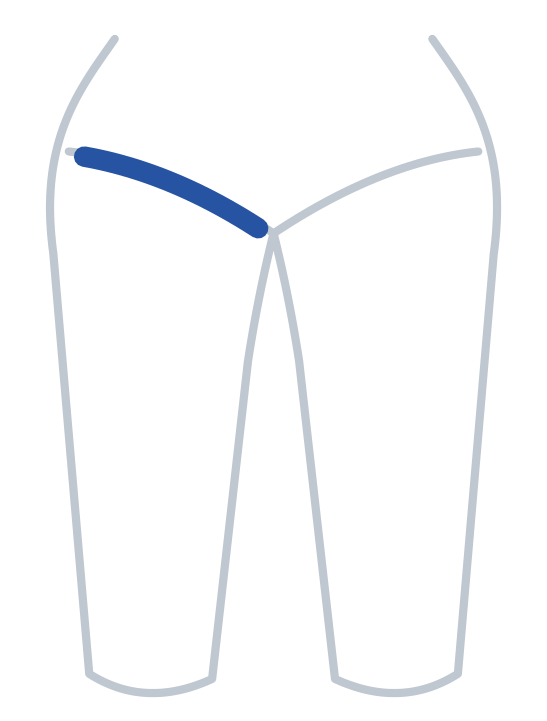
Selected upper inner-thigh laxity: a limited incision in the groin crease.
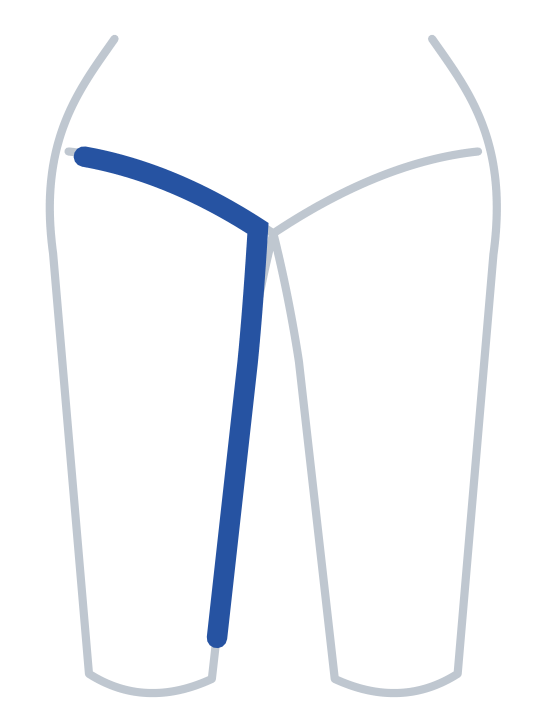
Groin crease plus a vertical incision down the inner thigh, shorter or toward the knee as needed.
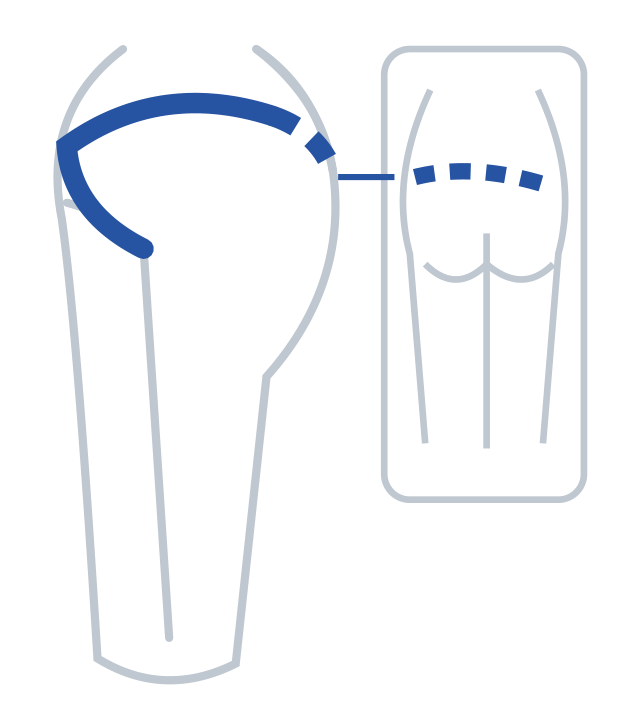
Groin around the hip toward the back; oblique view with a small posterior inset.

Clinical schematics, not an individual plan. The first two are front views, showing the patient’s right thigh on the viewer’s left; the vertical medial line is on the inner (not outer) thigh.
Deep support & closure
Deep support sutures may anchor the reshaped tissues; routine thigh-muscle tightening is not part of this description. Absorbable or removable sutures, adhesive, tape or clips may close the skin. Drains may be used.
Gradual results
Swelling and bruising can hide early contour changes. Compression is used only if prescribed, for an individual duration. Scars can be extensive and are permanent; concealment by swimwear is not guaranteed.
04 · After surgery
Recovery & results
Follow your written care plan. Healing and return to activity are individual; there is no fixed week when everyone is ready.
Early care
Dressings protect the incisions; drains may remove fluid or blood. Learn wound and drain care, medicines and when to contact the team.
Healing & review
Follow-up guides dressing, drain and suture removal and activity changes. Use a garment only as prescribed; do not tighten it yourself.
Settling over months
Swelling and bruising obscure early results. Final contours take months to settle; scars fade over months to a year or more, but remain permanent.
Protect healing incisions
- Use gentle mobility as prescribed. Your team tailors blood-clot prevention; this guide does not advise bed rest or prescribe medicines.
- Avoid tension, rubbing and excessive movement at groin incisions. Manage swelling according to your care plan.
- Arrange practical help for the first night and longer if needed; attend follow-up.
Ask before resuming activities
- How should I sit, stand, walk and use stairs?
- When can I work, drive, bathe and exercise?
- How do I manage dressings, drains, medicines and any prescribed garment? When should I return?
Keeping perspective
A stable weight and healthy habits may help maintain the change. Aging continues and laxity may recur. Results vary, no outcome is guaranteed and revision surgery may be needed.
When to seek help
Shortness of breath, chest pain or unusual heartbeats require immediate emergency medical attention. Contact your team promptly for fever, worsening redness or pain, or a wound opening.
05 · Informed decisions
Risks & safety
Weigh the possible benefits against the complications. Your surgeon should discuss risks specific to your operation and health before you consent.
Surgery & circulation
- Anesthesia risks
- Bleeding
- Infection
- Deep vein thrombosis (blood clots), cardiac and pulmonary complications
Wounds & tissue
- Poor wound healing
- Fluid accumulation (seroma)
- Major wound separation (dehiscence)
- Skin loss
- Death of fatty tissue beneath the skin (fat necrosis)
Skin & sensation
- Persistent pain
- Skin discoloration and/or prolonged swelling
- Numbness or other changes in skin sensation
Appearance & further care
- Asymmetry
- Sutures surfacing, becoming visible or causing irritation that may require removal
- Unfavorable scarring
- Recurrent skin laxity
- Possible revision surgery
An informed, procedure-specific decision
This is not a complete risk list. Ask which complications matter most for you, how risks are reduced, and how problems would be treated. Consent confirms understanding; it does not guarantee safety or a particular result.
When to seek help
Shortness of breath, chest pain or unusual heartbeats require immediate emergency medical attention. Contact your team promptly for fever, worsening redness or pain, or a wound opening.
06 · Planning ahead
Cost & choosing your surgeon
Choose a qualified, experienced plastic surgeon and an appropriate facility. Relevant experience, communication and safety matter, not price alone.
- Surgeon
- Anesthesia
- Facility
- Tests
- Medicines
Ask for a personalized written quote
Fees depend on the extent and technique, surgeon’s experience and location. Check surgeon, anesthesia and facility charges, tests, prescriptions, compression garments, dressings and follow-up. Ask what is included and how extra care or revision would be charged. No fee or financing arrangement is promised here.
Confirm insurance directly
Cosmetic surgery and its complications are often excluded. Ask your insurer to confirm your own policy’s terms in writing before booking. Do not assume local coverage, reimbursement or payment.
Questions for your surgeon
- What are your qualifications and experience in thigh lift and post-weight-loss body contouring?
- Why this incision pattern? What permanent scars, limits and alternatives should I expect?
- May I see relevant examples, understanding that my result may differ?
- Where will surgery take place, who provides anesthesia and what is the emergency plan?
- Who handles follow-up and complications, and how do I contact the team after hours?
Take time to consider the plan and ask questions. A shorter scar or lower fee should not take priority over an appropriate operation and a safe care pathway.
Book your consultation
Let’s talk about your goals
- Phone +961 1 746345
- WhatsApp +9613307854
- Email psi@psi-lb.com
- Address 63 Souraty Street, Hamra, Nassif Bldg, 1st Floor, Beirut, Lebanon
For general education only: not individualized medical advice or a treatment plan. This guide makes no representation, warranty or promise of outcome and does not replace a thorough, in-person consultation with a qualified, experienced plastic surgeon. Follow your own team’s instructions.
Further reading · Procedure (opens in a new tab) · Safety (opens in a new tab) · Recovery (opens in a new tab) · Thighplasty overview (opens in a new tab)