
Buccal Fat Removal
Understand cheek anatomy, irreversible change and the limits of facial contouring.
01 · Patient guide · Informed choices
The basics & your choices
Buccal fat reduction removes a selected amount from a deep cheek fat pad. It is an irreversible contouring operation, not weight-loss treatment or removal of all facial fat.
A specific pad, not all cheek fullness
The buccal fat pad is a naturally occurring compartment between facial muscles. Its size and contribution to cheek shape vary, and the two sides may differ. The operation aims to reduce selected lower-cheek fullness; it does not remove every facial fat compartment, narrow facial bones, treat all jaw fullness or tighten loose skin. It is distinct from liposuction, which treats different fat layers in selected areas.
Selection matters more than a trend
Your face does not need changing to be acceptable. Surgery should address your own considered goals, not pressure to achieve a fashionable hollow. A stable weight can make assessment more useful, but surgery is not a weight-management strategy. Naturally thin, narrow, mature or already volume-depleted faces may be unsuitable because further loss can exaggerate hollowing. No fixed age alone establishes suitability.
Permanent reduction, changing appearance
Removed tissue cannot simply be put back to restore the original pad. Facial fat distribution, skin support and aging continue to change. An initially pleasing result could look too hollow later, especially in a lean face. Hollowing is a possibility, not an inevitable outcome for everyone. Long-term evidence remains limited; a precise lifetime effect cannot be predicted from a short follow-up photograph.
Choosing no procedure is a valid option. Waiting, observing your natural facial changes or addressing a different cause of fullness may better meet your goals. Fillers do not make a face leaner, and additional procedures should not be bundled into a promise of an “ideal” face.
A surgeon may recommend limited, individualized reduction rather than removing the whole pad. More removal does not automatically create a better result. Exact symmetry, a particular cheek shadow and improved confidence cannot be guaranteed.
02 · Patient guide · Informed choices
Consultation & preparation
A careful in-person assessment asks what creates your cheek fullness and whether reducing this particular fat pad would suit your face over time.
Describe your priorities and history
Explain which changes you want and which features you wish to preserve. Bring previous facial surgery, dental or salivary problems, injury, filler and injection history, relevant photographs and medical records. Tell the team about allergies, nicotine or vaping, alcohol, all medicines, supplements and conditions affecting bleeding, anesthesia or healing. Mention jaw pain, restricted mouth opening, current dental infection or unexplained swelling.
Distinguish the source of fullness
The clinician examines facial proportions, existing asymmetry, skin support, cheek fat distribution and the masseter muscles. A broad jaw from muscle, superficial fat, bone structure or skin descent is not the same as an enlarged buccal pad. A new one-sided lump or swelling needs diagnosis, not automatic cosmetic reduction. Photographs require your consent and should support discussion rather than predict identical results.
Agree on alternatives and limits
Discuss no treatment, delay and whether another diagnosis needs attention first. Ask how future aging or weight change might affect the result, how much reduction is proposed and why preserving tissue may be safer. Imaging or dental review is used when clinically indicated, not automatically for everyone. Discuss emotional expectations without implying that a full face is a flaw.
Do not stop prescribed medicines on your own. Have the prescriber and surgical team coordinate any changes. Follow individualized instructions on nicotine cessation, fasting when required and mouth preparation. Treat dental or oral problems as directed before elective surgery rather than trying home remedies.
Clarify anesthesia and monitoring, transport after sedation or general anesthesia, adult support and childcare. Ask who can be contacted after hours and whether the planned setting can manage an emergency. A second opinion and time to reflect are reasonable.
03 · Patient guide · Informed choices
Anatomy & the procedure
The usual isolated procedure approaches the fat pad through the inside of the cheek. Important salivary and nerve structures are close by; this is surgery, not a simple cosmetic extraction.
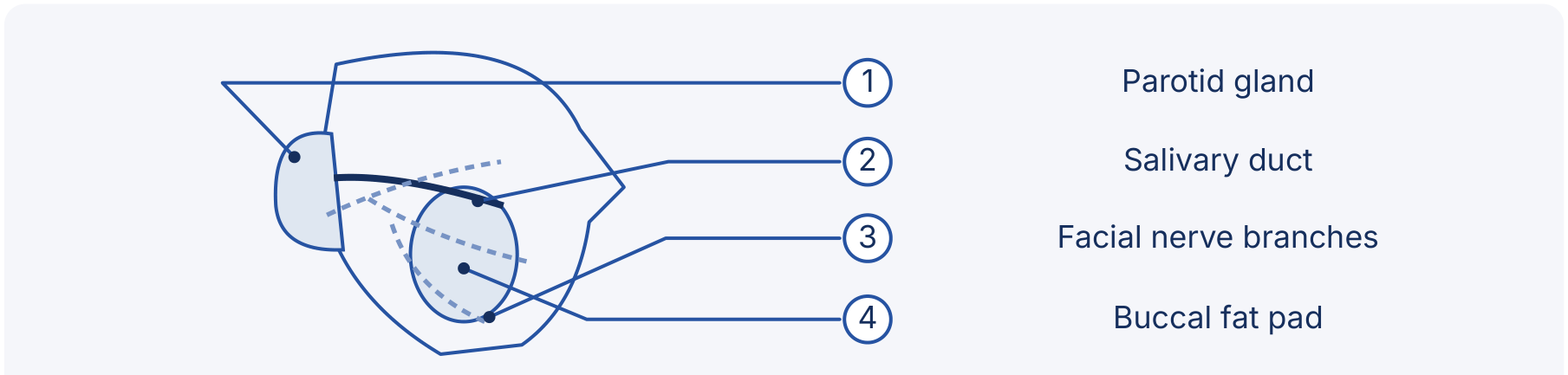
Nearby structures; variable anatomy
Simplified schematic, not to scale or an operative plan. Individual anatomy varies.
Plan conservative, individualized reduction
Local anesthesia, sedation or general anesthesia may be selected according to the operation and your health. The setting must provide appropriate monitoring and qualified personnel. An incision inside the cheek allows the surgeon to access the buccal pad, reduce a selected portion, control bleeding and close the lining, often with absorbable sutures. The amount is individualized and need not be identical on both sides. Entire-pad removal is not a routine goal.
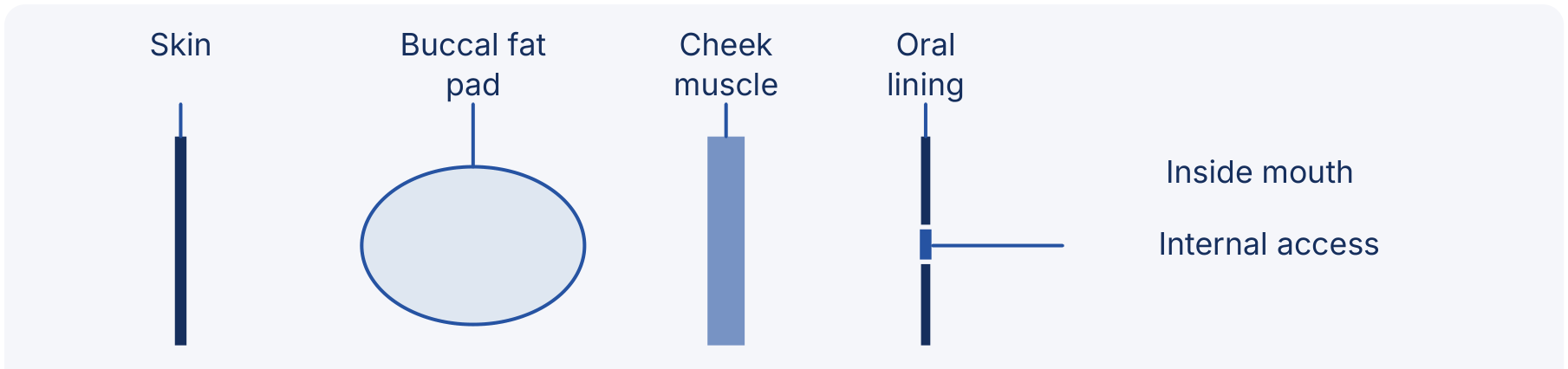
Limited pad reduction; not all facial fat
Simplified schematic, not to scale or an operative plan. Individual anatomy varies.
The parotid duct carries saliva from the parotid gland into the mouth; facial nerve branches help move facial muscles. Their relationships to the fat pad vary. Damage can cause salivary leakage or facial weakness. These schematics identify concepts only: they give no safe incision coordinates, dissection angles or instructions for self-treatment.
What the approach does not do
An intraoral approach avoids a skin incision for an isolated procedure, but internal scars and other risks remain. It is not liposuction of the whole cheek and does not automatically lift skin or treat jaw-muscle enlargement. Extra facial procedures require their own indication and consent. Removing too much or forcing tissue removal can increase injury and contour problems.
You should receive a clear explanation of the proposed extent, alternatives, expected limitations and the plan if findings differ from the assessment. Early swelling hides the effect; the appearance immediately after surgery is not a guide to the final contour. No drawing or photograph promises your result.
04 · Patient guide · Informed choices
Recovery & daily care
Healing takes place inside the mouth as well as within the cheek. Follow your own team’s written instructions for hygiene, eating, medicines and activity.
Protect the mouth incision
Follow the prescribed oral-hygiene plan, including any special rinse and instructions for brushing near the wound. Use products only as directed. Do not pick the incision with a finger or tongue, pull sutures, apply hydrogen peroxide as a home treatment or probe a swollen area. Mouth cleanliness matters, but vigorous manipulation can irritate healing tissue. Antibiotics are not a universal instruction: take them only if prescribed for your situation.
Eat and drink as directed
The team may recommend liquids or soft foods initially, then a modified diet as tolerated and cleared. Ask how to maintain hydration and nutrition and when to advance textures. Do not force chewing through increasing pain or restricted opening. Report problems swallowing or drinking. Your individual plan takes priority over a fixed online number of days.
Activity and gradual change
Swelling, bruising, soreness and some tightness can occur early. Keep review visits so healing, symmetry and mouth opening can be checked. Avoid strenuous activity until cleared. Ask about work, driving, childcare, exercise and travel; do not drive while impaired by sedation or medicines. Do not start cheek massage unless the surgeon specifically directs it. Shape becomes clearer over weeks to months as swelling settles, without a guaranteed deadline.
Contact the team urgently for sudden large swelling, increasing or severe pain, fever, redness, pus, worsening mouth opening, new facial weakness or persistent fluid leakage. Swelling or drainage that increases with meals can suggest a salivary problem and needs review, not self-massage. Difficulty breathing, chest pain or collapse requires emergency care.
If a follow-up date or contact number is unclear, obtain it before leaving. Do not assume that every swelling or asymmetry is temporary without an examination.
05 · Patient guide · Informed choices
Risks & informed consent
Weigh a possible reduction in cheek fullness against permanent tissue loss, surgical complications and uncertainty about how your face will change with age.
Surgical and general risks
Bleeding, hematoma, fluid collection, infection, persistent pain, numbness or altered sensation, poor wound healing, internal scarring and prolonged swelling are possible. Trismus means difficulty opening the mouth and can affect eating or oral hygiene. Anesthesia complications, blood clots and cardiac or pulmonary problems also need discussion. Personal risks depend on your health, anatomy, combined procedures and the setting.
Nearby structures can be injured
Parotid duct injury can cause saliva to leak into tissues, collect as a sialocele or drain through an abnormal passage called a fistula. Investigation and additional treatment may be needed. Injury to branches of the facial nerve can cause temporary or permanent weakness of facial muscles, affecting expression or the smile. An incision inside the mouth does not eliminate either risk. Ask how the team identifies and manages these complications.
Contour and long-term trade-offs
Asymmetry, uneven contour, over-resection, excessive hollowing, minimal visible improvement or dissatisfaction can occur. The removed tissue is not readily replaceable. Later fat grafting, fillers or revision may be discussed for a problem, but they do not reliably recreate the original pad or fully correct every outcome. Further procedures have risks of their own and should not be sold as a guaranteed reversal.
Systematic reviews report limited-quality evidence and restricted follow-up; reported complication rates vary with study methods and definitions. Long-term aging effects remain uncertain. The absence of an injury in a small study is not proof of zero risk, and an anatomical variation percentage is not your personal complication rate.
Consent should include the possibility of doing nothing, keeping a fuller cheek and changing your mind before surgery. Ask which risks are most relevant to your face and how they would be managed.
06 · Patient guide · Informed choices
Choosing your surgeon & cost
Choose relevant anatomical expertise, a suitable clinical setting and dependable follow-up. A low fee or a social-media trend is not a substitute for a sound indication.
Check the surgeon and setting
Look for appropriate qualifications and authorization to practice, relevant facial-surgery experience and a detailed understanding of salivary ducts, facial nerves and fat compartments. Ask who provides anesthesia, where you will be monitored and how emergencies are handled. A qualified team should be comfortable recommending against reduction when the anatomy or expectations make it unsuitable. This guide does not assert a board certification or membership.
Request an itemized estimate
Ask about the surgeon’s fee, anesthesia, facility charges, any indicated tests or oral/dental assessment, prescribed medicines, follow-up and management of unexpected findings. Clarify whether additional facial procedures are separate. Ask what happens financially if you need extra visits, treatment of a salivary leak, admission or revision. No specific price, payment plan or local treatment availability is promised in this guide.
Check any insurance questions directly with your insurer and your own policy. Obtain written answers about the proposed surgery, possible complications, exclusions, prior approval and personal costs. Do not infer local coverage or reimbursement from the fact that an operation is performed in a clinical setting. Include time off work, transport and practical support in your planning.
Useful questions for the consultation
What is actually causing my cheek fullness? Why would this pad be reduced rather than left alone? How might a leaner or older face look later? What amount is planned and what will remain? What limitations should I expect? Who checks my smile, oral wound and salivary symptoms afterward? Whom should I contact if swelling increases with meals or mouth opening becomes difficult?
Take time to consider the written plan, including no surgery. You do not owe anyone a thinner face, and deciding to keep your natural fullness is not a failed consultation. Choose a team that respects your priorities and explains uncertainty honestly rather than promising a fashionable or permanent “perfect” contour.
Patient guide · Informed choices
Let’s talk about your priorities
- Phone +961 1 746345
- WhatsApp +9613307854
- Email psi@psi-lb.com
- Address 63 Souraty Street, Hamra, Nassif Bldg, 1st Floor, Beirut, Lebanon
Bring this guide, your questions and relevant records to the consultation. Ask for a personal plan, written aftercare and a clear emergency contact. Not every technique described is offered or locally available.
This guide provides general education only, not individualized medical advice or a treatment plan. It makes no representations, warranties or guarantees about outcomes and does not replace a thorough, in-person consultation with a qualified, experienced plastic surgeon. Follow your treating team’s instructions.
Sources and further reading
ASPS · Risks (opens in a new tab) · ASPS · Recovery (opens in a new tab) · Academic review · Duct injury (opens in a new tab) · Systematic review · Long-term uncertainty (opens in a new tab)