
Breast Lift
Mastopexy
Everything you need to know, from your first consultation to your final result.
01 · The basics
What is a breast lift?
A breast lift, or mastopexy, raises and reshapes the breasts by removing excess skin and tightening the supporting tissues. It can also reduce an enlarged areola, the pigmented skin around the nipple.
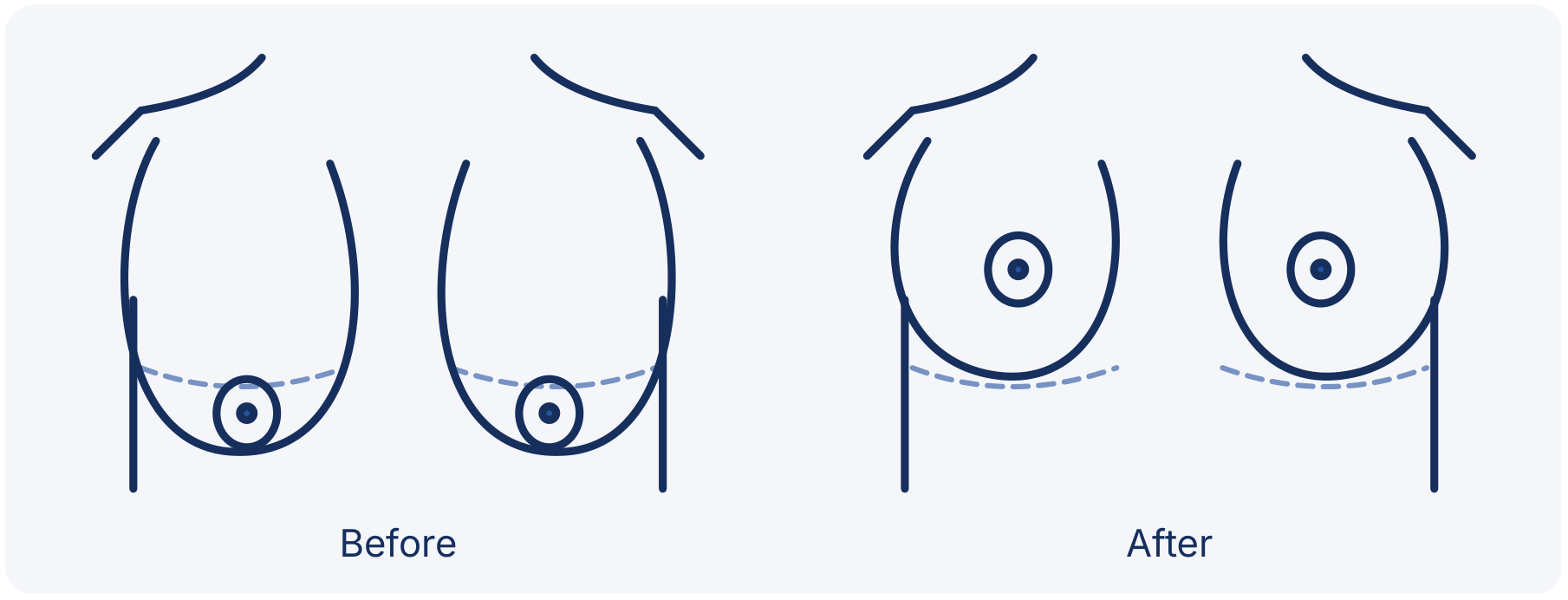
Schematic only: not guaranteed results. Breast and nipple position are shown for explanation, not as a prediction of your outcome.
Why breasts change
Pregnancy, breastfeeding, weight fluctuations, aging, gravity and heredity can change breast shape and firmness as skin loses elasticity.
Could a breast lift be right for you?
Choose surgery for yourself, not to meet someone else’s wishes or an ideal image. Suitable candidates are physically healthy, have a stable weight, do not smoke and have realistic expectations.
- Sagging, flatter, elongated or pendulous breasts; loss of shape or volume
- Nipples below the breast crease when unsupported, or nipples and areolas pointing downward
- Stretched skin, enlarged areolas, or one breast sitting lower than the other
A lift is not the same as augmentation
A lift does not substantially change breast size. An optional implant can add upper-breast fullness; it may be placed during the lift or in a separate operation. Implants are not required for a breast lift. Discuss future pregnancy or major weight changes, which can alter the result.
02 · Before surgery
Consultation & preparation
An open discussion of your health, expectations and concerns helps your surgeon plan an individualized operation. Feeling anxious is natural; bring your questions and feelings to the consultation.
Come ready to discuss
- Your goals; medical conditions, drug allergies and treatments
- All medicines, vitamins and herbal supplements; alcohol, tobacco and drug use
- Previous operations, family history of breast cancer, and results of mammograms or breast biopsies
Your surgeon will
- Review your health and risk factors; examine and measure breast size, shape, skin quality and nipple/areola position
- Take photographs for your record and discuss treatment options
- Explain the proposed plan, anesthesia, likely results, risks and possible complications
Getting ready for surgery
Depending on your health and surgical plan, you may be asked to:
- Have lab tests or a medical evaluation
- Review medicines with your surgeon
- Stop smoking as instructed
- Review medicines that may increase bleeding
- Arrange a ride and overnight support
You may be asked to have a baseline mammogram before surgery and another afterward to help identify future changes in breast tissue. This is not a blanket requirement for every patient.
Medication instructions are individual. Aspirin, anti-inflammatory medicines and herbal supplements may increase the risk of bleeding. Do not stop or change prescribed medicines unless your surgeon instructs you to do so.
Surgery may take place in an accredited office-based surgical facility, a licensed outpatient center or a hospital. Arrange someone to drive you to and from surgery and stay with you for at least the first night.
03 · On the day
The procedure, step by step
The technique depends on breast size and shape, areola size and position, the degree of sagging, skin elasticity and the amount of excess skin.
Anesthesia
Intravenous sedation or general anesthesia keeps you comfortable. Your surgeon will recommend the appropriate option.
The incisions
Three common patterns are shown below. The choice should fit your anatomy and the correction needed, rather than simply aim for the shortest scar.
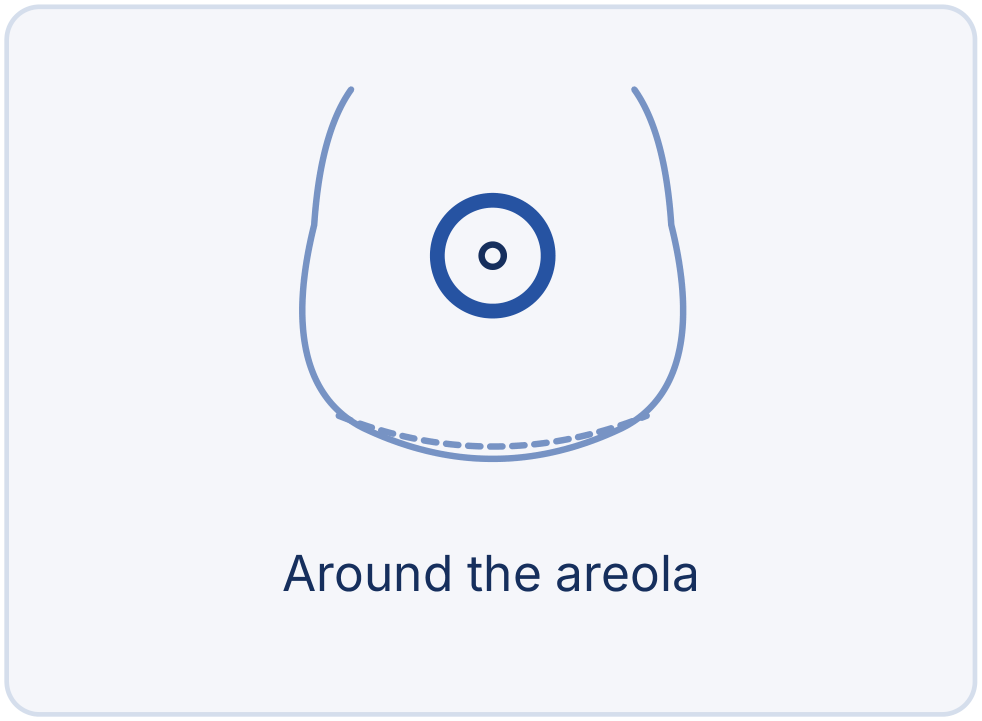
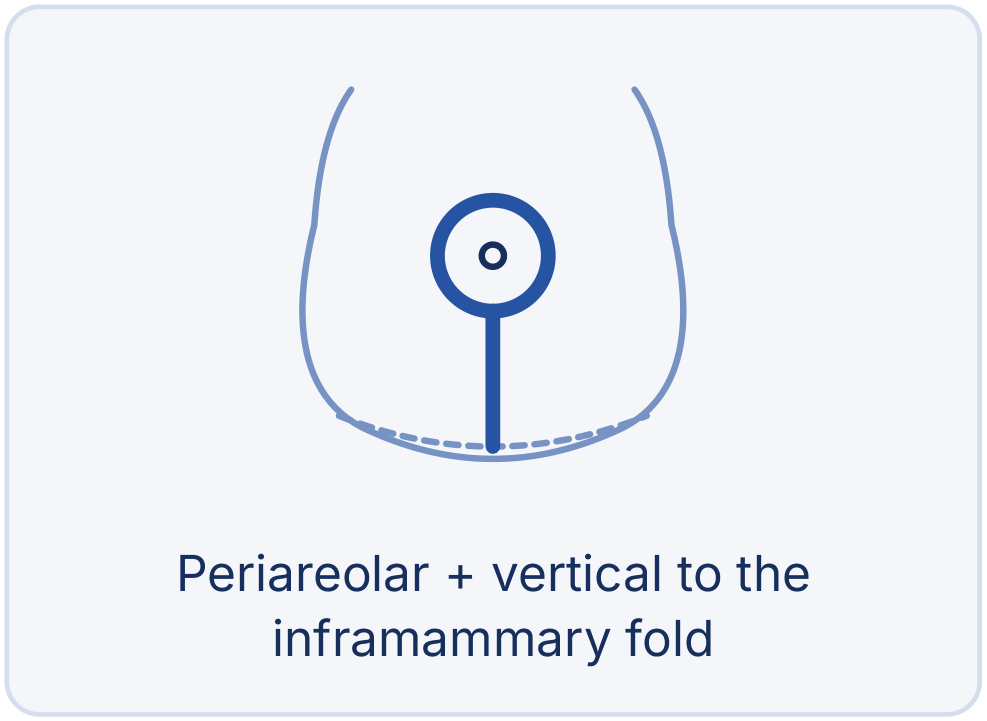
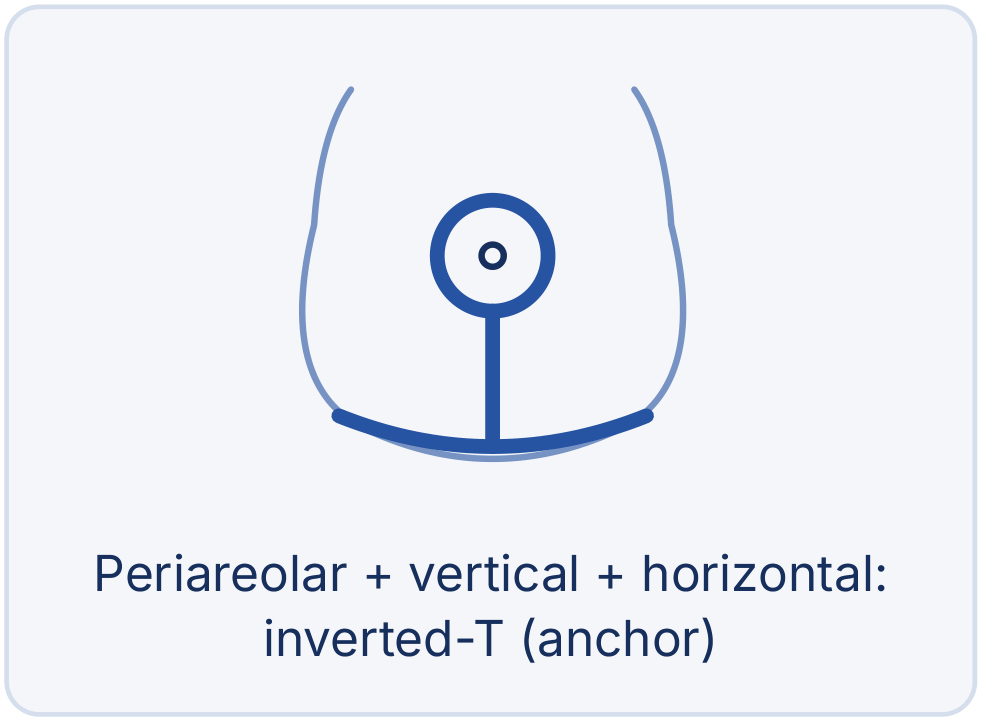
Front-view schematics of one breast. Bold blue lines show incision patterns; the faint lower curve marks the inframammary fold (the crease beneath the breast). Not to scale.
Reshaping and lifting
The underlying breast tissue is lifted and reshaped. The nipple and areola are moved together to a higher position, usually remaining attached to the underlying tissue and its blood supply. An enlarged areola can be reduced by removing skin at its edge; excess breast skin is removed.
Closing the incisions
Deep sutures support the reshaped breast. Sutures, skin adhesive and/or surgical tape close the skin. Some scars follow natural contours; others remain visible on the breast. Scars are permanent, although they usually fade.
Seeing the change
The change in position can be visible immediately, but swelling initially affects the appearance. Breast shape and position continue to settle over the next few months.


04 · After surgery
Recovery & results
Follow your surgeon’s instructions closely. Your aftercare and return to activity are tailored to your operation and healing, not a fixed calendar.
Immediately
Dressings & support
Incisions are dressed. An elastic bandage or support bra helps limit swelling and supports the breasts.
Early healing
Care & review
A small drain may temporarily remove blood or fluid. Follow instructions on wound care, medicines and follow-up.
Next few months
Shape settles
Swelling eases as the breast shape and position settle. Keep your planned review appointments.
Long term
Protect the result
Scars remain but fade. Aging and gravity continue; stable weight and a healthy lifestyle help maintain the result.
General stages, not deadlines. Your own recovery depends on your health, procedure and your surgeon’s instructions.
Your aftercare instructions
- How to care for your breasts, incisions and any drains
- Medicines to apply or take to aid healing and reduce infection risk
- Changes to watch for at the surgical site or in your general health
- When to attend follow-up and how to contact your surgical team
Questions to ask
- Where will I go after surgery, and what medicines will I receive?
- When are dressings, drains or stitches removed, if needed?
- How should I bathe, and how long should I wear a support bra?
- When can I return to normal activity and exercise?
- When is my follow-up appointment?
Protect healing tissues
Avoid tension, rubbing and excessive movement at the incisions while healing. Follow your surgeon’s instructions to help reduce swelling.
Results and future changes
Results can be long lasting, but no outcome is guaranteed and revision may be needed. Scars are permanent even as they fade. Pregnancy can reduce or reverse the improvement, and major weight changes can affect appearance. If you are considering a future pregnancy, discuss the best timing for surgery.
05 · Informed decisions
Risks & safety
Only you can decide whether the benefits of a breast lift are worth its risks. Consent forms confirm that you understand the operation and its possible complications.
Discuss all of the following with your surgeon, along with any risks specific to your health and treatment plan.
Surgical & general
- Anesthesia risks
- Bleeding or hematoma (a collection of blood)
- Infection
- Deep vein thrombosis (blood clots)
- Heart and lung complications
Healing & tissues
- Poor healing of incisions
- Fluid accumulation
- Fat necrosis (damage and death of fatty tissue)
Nipple & sensation
- Temporary or permanent changes in nipple or breast sensation
- Partial or total necrosis (tissue loss) of the nipple and areola
Appearance
- Breast contour or shape irregularities
- Breast asymmetry
Further treatment
- Revision surgery may be necessary
- Breastfeeding after surgery cannot be guaranteed.
Your questions matter
Each of these risks, and any others that apply to you, will be explained before you give consent. Address every question directly with your plastic surgeon; no question is too small.
06 · Planning ahead
Cost & choosing your surgeon
The cost of a breast lift varies with the surgeon’s experience, the procedure and the practice location. Ask for an individualized estimate and whether financing is available.
What the total may include
- Surgeon’s fee
- Anesthesia fees
- Hospital or facility costs
- Medical tests
- Support bra & prescribed medicines
Implants: only if used
If you choose an optional implant, its cost should be included in your estimate. Ask what is included in the total, including follow-up and any additional procedure.
A note on insurance
Most health insurance plans do not cover a cosmetic breast lift. Review your own policy carefully before booking.
More than a fee
When you choose a surgeon for your breast lift, their experience and how comfortable you feel with them matter just as much as the final price.
Plastic surgery involves many choices. The first, and most important, is choosing a qualified, experienced plastic surgeon you can trust.
What to look for
Before you decide, make sure your surgeon:
- Is a qualified plastic surgeon, specialized in plastic, reconstructive and aesthetic surgery
- Has completed full surgical training at a recognized institution
- Has solid experience with breast lifts and can show you examples of results
- Operates in an accredited facility equipped to keep you safe
- Takes the time to answer all your questions and explains the risks clearly
Feel free to ask your surgeon about their training and experience. A surgeon you can trust will be happy to answer.
Book your consultation
Let’s talk about your goals
- Phone +961 1 746345
- WhatsApp +9613307854
- Email psi@psi-lb.com
- Address 63 Souraty Street, Hamra, Nassif Bldg, 1st Floor, Beirut, Lebanon
This guide is for general educational purposes only. It makes no promise or guarantee about the outcome of any procedure and is not a substitute for a thorough, in-person consultation with a qualified plastic surgeon.